Euclidean Sequencer For Modular Synthesizers

euclidean-sequencer

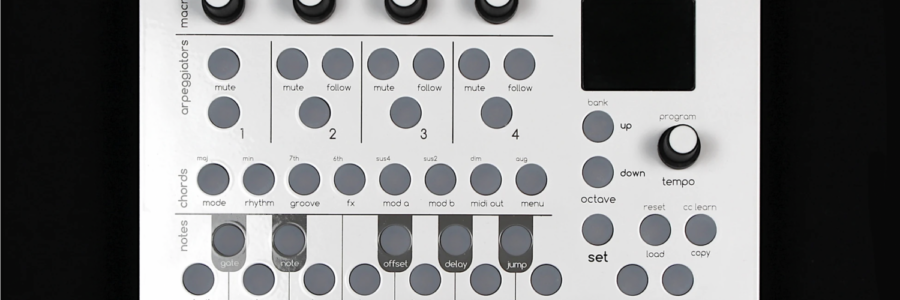
Club Of The Knobs has introduced the C969 Euclidean Bi-Clock Sequencer, a new modular for Moog style modular synthesizers.

The Euclidean sequencer is a 4-channel gate sequencer, ‘specially suited for he creation of poly-rhythms’. Each sequence can be from 2 to 32 steps in length.

In addition to delivering the gate sequence to two outputs, the ‘silent steps’ in the sequence are available via a ‘Silence Gate Out’.

The idea of ‘Euclidean Rhythms’ was discussed by computer scientist Godfried Toussaint in his paper The Euclidean Algorithm Generates Traditional Musical Rhythms (pdf). He argues that the Euclidean algorithm may be used to generate ‘a large family of rhythms used as timelines (ostinatos), in sub-Saharan African music in particular, and world music in general. These rhythms have the property that their onset patterns are distributed as evenly as possible.’

Continue reading

Tuvan Throat Singing & MIDI Theremin Jam

YouTube Preview Image

Sunday Synth Jams: Peter Pringle makes a return appearance with this awesome and bizarre Tuvan Throat Singing & Theremin jam.

Tuvan throat singing involves controlling the shape of the mouth and throat in order to emphasize specific overtones. This creates the effect that the performer is singing two notes at once.

Detail on the performance below. Continue reading

Audio Examples From The New Elektron Analog Four Voice Synthesizer

YouTube Preview Image

Elektron has posted another teaser for its upcoming hardware product.

They haven’t said anything about it yet, other than it offers ‘Traditional & Futuristic Sounds’ and that it’s coming in 2012. Previously, they’ve shared photos of the new gear.

Continue reading

Dark Energy 2 Synthesizer Offers 100% Analog Sound

Doepfer has updated its site with information on the Dark Energy 2 synthesizer, which is shipping, but the first production series is already completely pre-ordered.

The original Dark Energy had to be discontinued because an important electronic part (CEM3394) is no longer available. The new Dark Energy II looks like the Dark Energy I, but the basic sound of Dark Energy II is different, because of the new circuits for VCO, VCF and VCA.

Dark Energy II is a monophonic stand-alone synthesizer with USB and Midi interface. The sound generation and all modulation sources are 100% analog, only the USB/Midi interface contains digital components. Dark Energy is built into a rugged black metal case with wooden side plates. Potentiometers with metal shafts are used and each potentiometer - except the filter mode control - is fixed to the case (no wobbly shafts and knobs). The distance between the controls is a bit wider compared to A-100 modules and knobs with vintage look are used.

Here are the key differences between the Dark Energy I and II:

  • 12dB multimode filter with lowpass, notch, highpass and bandpass (instead of 24dB lowpass of Dark Energy I)
  • the previous LM control of the filter becomes the filter type control Mode (continuous crossfade lowpass – notch – highpass – bandpass)
  • the modulation level control of the filter “XFM” has so-called “polarizer” function. The modulation source (LFO2 or ADSR) selected by the Source switch may affect the filter frequency in a positive (right half of the control range) or negative way (left half of the control range)
  • the waveform switch is used to select between saw and clipped, inverted saw (in the center position the saw is off)
  • the basic waveform of the VCO is saw (not triangle like the Dark Energy I).
  • the VCA has a exponential scale (not the combined linear/exponential scale of Dark Energy I)
  • because of the pure analog circuit and the temperature control it may take up to 20-30 minutes until the VCO is in tune.
  • The sound of the Dark Energy II differs clearly from the Dark Energy I (mainly because of the completely different filter type). If you already own a Dark Energy I, the Dark Energy II can be used as an expansion. But you will not be able to copy sounds of the Dark Energy I with the Dark Energy II (and vice versa).
  • For users with electronic knowledge the Dark Energy II offers much more internal expansion features than the Dark Energy I. For example terminals (pin headers) for these features are available: VCO Hard Sync, linear VCO FM, rectangle and sawtoooth output of the VCO, lowpass/bandpass/highpass output of the VC, Reset/Sync/Direction for each LFO, rectangle and triangle output for each LFO. In addition an improved version of the glide option is is the planning stage that allows to turn on/off the glide function via Midi control change messages.

The Doepfer Dark Energy 2 is priced at Euro 428,00. At current time, the existing stock has been pre-ordered. See the Doepfer site for details on ordering.

Continue reading