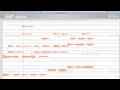
DNA
Articles about DNA:
Non Eric´s erste Tests mit Celemony Melodyne DNA!
via musotalk:
Ich habe meine ersten Minuten mit der Beta des neuen Melodyne Editors mit DNA für euch als Screencast ins Netz gestellt.Für mich die absolute Softwaresensation der letzten 2 Jahre.Mehr in Kürze nach ausgiebigeren Tests,
Melodyne Editor Beta Preview
Celemony product designer Stefan Lindlahr introduces the beta test for Melodyne Editor and DNA (Direct Note Access).
DNA technology is designed to allow the editing of individual chord tones in audio recordings. This will let you do things like change a track from major to minor, edit one instrument out of a mix and, in general, edit notes in polyphonic recorded audio.
Lindlahr shows you how to download and install the beta version of Melodyne editor, how to load audio files and how they are organized on your hard disk.
More information on the Celemony Melodyne Editor beta program is available at the Celemony site. Read more…
Send to a Friend
|
Feed for this Entry |
Filed under: Computer Music, Software Effects & Audio Processors, User Reviews
2009 NAMM Show: Celemony Software introduced Melodyne Editor, the first product with Direct Note Access (DNA). DNA technology allows, for the first time, the editing of individual chord tones in audio recordings.
Melodyne editor provides all the editing functions of the existing editions of Melodyne. With the integration of DNA, though, the harmonies in an audio file can now be seen, accessed and shaped—note by note.
Melodyne Editor lets you visualize and change individual notes within chords in a recording. This offers fantastic new possibilities for the correction and refashioning of audio.
Melodyne editor is designed for the editing of individual instrumental recordings such as vocals, guitar, saxophone or piano, but good results can also be obtained with more complex material such as string quartets. If two instruments sound the same note at the same time, Melodyne editor offers one note for editing. The user can alter the pitch, position and duration of the note detected, make it louder or quieter, copy or cut it and paste it in some other position, and so on. Adjustments can also be made to the formant register, vibrato and drift of the notes as well as any pitch, volume or formant transitions. Special copying functions also allow the transfer of selected attributes from one note to another.
Melodyne editor can run as a plug-in or stand-alone and will be available from spring 2009 for 349 US$/€. Read more…
Send to a Friend
|
Feed for this Entry |
Filed under: Computer Music, Software Effects & Audio Processors, Software Synthesizers & Samplers
Celemony Software is presenting at the 2009 NAMM Show the Melodyne editor, the first product with Direct Note Access (DNA).
DNA technology lets you, for the first time, edit individual chord tones in audio recordings.
Melodyne editor offers for single audio tracks all the possibilities that have made Melodyne legendary, and, with DNA, opens up in addition to these unique new possibilities for the correction and refashioning of audio material. Melodyne editor can run as a plug-in or stand-alone and will be available from spring 2009 for 349 US$/€.
This opens up reams of creative possibilities for audio editing. At the most obvious level, imagine automatically changing a audio mix from major to minor. At a more advanced level, DNA makes it possible to reharmonized fully arranged recorded material.
There’s a great article by Suzanne Vega today at the New York Times.
In it, Vega talks about her song Tom’s Diner getting remixed, illegally, by DNA:
We were backstage at the Arsenio Hall show when my manager told me that some boys calling themselves DNA, in England — Bath, to be specific — had taken “Tom’s Diner” and put a dance track to it. They had “re-mixed” it. (I don’t remember what we called that type of music back then — house? rap? hip-hop? It wasn’t “disco” or “thrash-metal.”) My manager, Ron Fierstein, told me that A&M and Polygram were considering taking legal action against them for copyright violation.
I thought, well, let me listen to it — and immediately liked it. It made me laugh. It wasn’t a parody, which is what I was afraid of. The song is the same, my voice is still my voice, the story still the story, even though they left out the very end (they told me later they thought it sounded weird, musically, to keep the ending).
Instead of sending the boys to jail, my manager worked out a deal with them for a flat fee. A&M Records paid the fee, and we retained all rights.
I made the decision to call the remix “Tom’s Diner, by DNA featuring Suzanne Vega” because I didn’t know if the audience would accept the new sound, and I wanted to make it clear that it wasn’t my production. To my surprise, I didn’t have to worry about that as it was accepted everywhere. DNA were surprised to find themselves suddenly classified as an “act,” since they did mostly production.
I had imagined that a few dance clubs would play it, and that would be the end of it. But it was played on radio right away, including the R&B stations, a new experience for me. I even received a plaque congratulating me for having one of the most played R&B songs of 1990. R&B! How cool.
Vega goes on to talk about all the other remixes of Tom’s Diner that this led to, and how Tom’s Diner was used by the creators of the MP3 format to test their compression algorithms.
It’s a great article, touching on digital media, copyright and the benefits of working with people that want to remix your work.