experimental electronic musical instrument
Articles about experimental electronic musical instrument:
The ANS synthesizer (named after Alexander Nikolayevich Scriabin) is a photoelectronic musical instrument created by Russian engineer Evgeny Murzin between 1937 to 1957.
The synthesizers uses cinematography, which makes it possible to “photograph” a sound wave, as well as synthesizing a sound from a drawn sound wave.
The introduction is in Russian, but about 4:15 into the video, the ANS synthesizer is demonstrated.
Here’s a Googlish translation of the text that accompanies the video:
Synthesizer [ANS] photoelectronic musical tool is designed by Russian inventor by Eugene [Murzinym] in 1958. With the aid of [ANSa] the composer can create music of any colorings in the directly reverberating form, without the musicians of executors, he writes sounds on the glass, necessary to it, covered with the opaque nondrying paint, removing by cutters paint in the specific places. This glass- is the unique musical score of tool, working on the musical score of synthesizer, composer it becomes similar to artist, who records the picture: it tints, it retouches, it erases and new code figures are brought, achieving auditory control of the obtained result.
The freedom of work in this musical score conceals the inexhaustible possibilities.
Invention was named by the designer “OF [ANS]” in the honor of composer Alexander Nikolayevich [Skryabina]. The large part of the music to the films Andrey Tarkovsky [Eduard] [Artemev] wrote with the aid of [ANS].
Video demonstrates experiment; [ANS] reproduces the figure of the artist of Svetlana [Bogatyr] ” Unknown Of [miry]“. On October 21, 2009 [GTSMMK] [im]. OF [M].[I]. Of [glinki] concert [posvyashchennyy] to 95- anniversary from the birthday of Eugene Alexandrovich [Murzina].
If you can summarize the commentary from the video, leave a comment below! Read more…
Tonewheels is an experiment in converting graphical imagery to sound, inspired by some of the pioneering 20th Century electronic music inventions. We previewed Tonewheels a few months ago.
Transparent tonewheels with repeating patterns are spun over light-sensitive electronic circuitry to produce sound and light pulsations and textures. This all-analog set is performed entirely live without the use of computers, using only overhead projectors as light source, performance interface and audience display.
In this way, Tonewheels aims to open up the “black box” of electronic music and video by exposing the working processes of the performance for the audience to see.
Derek Holzer: sounds, electronics
umatic.nl/tonewheels.html
ResoDrum Demo
The ResoDrum is an electronic instrument played like a hand drum. It is both sensor and speaker.
The sounds you are hearing are coming from the ResoDrum itself, via a transducer bolted to the underside. Tap on it lightly and you get small percussion sounds; hit it hard and it goes berserk.
(Note that the audio and video are slightly out of sync. The ResoDrum reacts without noticeable latency.) Read more…
Times are touch, life is hard, and if you’re like me, you’re making your gear choices very carefully.
New technology, though, offers an alternative to expensive gear, effectively letting you laser print your music gear.
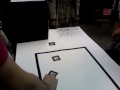
Check out ARDJ (Augmented Reality DJ) – an experimental DJ control system. By choosing which printed symbols are placed in the playing area, and how they are placed, you control the playback of audio loops.
See our previous post on augmented reality DJ scratching, for another example of how computers and cheap video cameras are changing music-making. Read more…
Bizarre Cigar Box Synthesizer

Critter and Guitari’s Keypad Cigar Box Synthesizer is described as the best synth for $100!
Here’s a preview of what this boxed beast sound like:
Description:
This is a synthesizer with keypad pitch control. The 16 keys play chromatically, so you get an octave plus 3 notes. It produces sound using a simple frequency modulation oscillator pair. The four knobs control volume, tuning (shifts the base pitch of the keypad up and down), harmonicity, and modulation-depth-waveform. The modulation-depth-waveform is a combo-control that varies the modulation depth and changes the waveform of the oscillators from sine to triangle.
It is a nice and loud instrument, powered with a 9 volt battery. A 1/4″ switched output jack bypasses the speaker and allows the synth to be plugged into an external amplifier / effects.