Fairlight CMI
Articles about Fairlight CMI:
Send to a Friend
|
Feed for this Entry |
Filed under: Keyboard Synthesizers, Music News, Synthesizers
If you’ve really been aching to see Ms March with a monster synth, the APC crew has got you covered.
While the site of a large modular synth, a Roland TB 303 or a Fairlight CMI III is titillation enough for most synth freaks, the 2010 APC calendar goes a step further.
Here’s what APC’s Simon Iddol has to say about their 2010 calendar:
The calendar itself is a limited edition (500 copies) A3 sized wall calendar featuring legendary synths like Fairlight CMI III, Roland TB 303, PPG Wave, EMS AKS or Roland Jupiter 8.
Our aim is to create a calendar like this in every year and to do something for the music world like the Pirelli calendar for the car world.
If every garage has a hot chick VS cool cars calendar, than every studio needs our calendar.
The model is a world famous Hungarian striptease dancer and model Dorothy Black.
The politically correct side of me thinks that they should have balanced out the gear photos featuring the “world famous Hungarian striptease dancer” with some shots with a hunky naked guy – but photos of naked guys with monster synths would probably kill the vintage synth resale market on eBay forever.
The calendars are $30 via PayPal. Details at the APC site.
SFW preview (that’s probably NSFW) here.
Peter Vogel has posted additional information on the new Fairlight CMI 30A at the Fairlight site.
Unfortunately, the projected price for the new Fairlight CMI 30A is expected to be approximately US $17,000 and the additional music keyboard option US $2,000.
Here’s what that $17,000 will buy you:
Description:
The CMI-30A will utilise the immense power of the latest Fairlight Crystal Core media processor (CC-1). It will not only faithfully reproduce the original sound but go well beyond the original capabilities in a dramatically smaller and more reliable physical form.
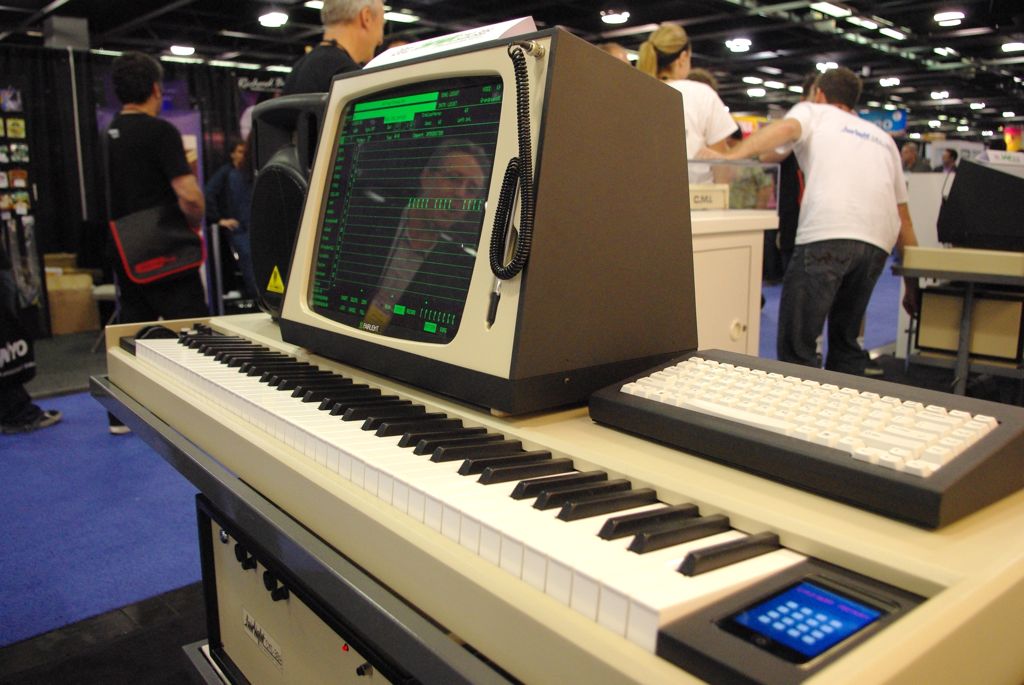
The 30A will look like and perform like the original CMI, although the mainframe will be much lighter, for portability. The look and feel of the user interface will also be similar to the original, with classic retro green on black graphics. A replica of the original music keyboard will also be available as an option, or you can use your own MIDI keyboard.
The software will combine the very best of the early Series II and III, with a number of significant new features. Sound quality of 8-bit, 16-bit, or “best quality” 36-bit floating point can be selected and existing Fairlight users can import their entire sample libraries. Even better, non-Fairlight sounds from any source, such as WAV files, can be imported and played with the classic Fairlight sound.
The Fairlight 30A will have sixteen analogue and one digital (MADI) output. However, unlike the earlier CMIs, any one physical output could offer dozens of voices.
All the original Fairlight sound libraries from both the CMI-IIX and the III will be included, plus a huge selection of samples collected from the past 30 years.
Send to a Friend
|
Feed for this Entry |
Filed under: Electronic Instruments, Keyboard Synthesizers, Samplers, Sequencers, Workstations
Fairlight’s Peter Vogel has shared more info about the 30th Anniversary Fairlight CMI 30A:
The CC-1 can perform very complex algorithms and lots of them, with almost no latency. So yes, we are modelling the quirky hardware of the CMI. The sound of each CMI was subtly different, due to their analogue bits, so it won’t sound exactly like any one CMI, but lined up with a few CMIs you won’t be able to tell the difference.
The sound will be user selectable, to be like a series I,II,IIX, III etc. Or you can dig deeper and make it sound like nothing else.
One of the many nice things about the CC-1 is that it has no inherent bit width. “Normal” processors generally offer say 32 or 64 bit operations, where as the CC-1 can be configured to any number of bits. So if something works most effectively as 33 bits, so be it. And the bit widths can be mixed within the one signal path.
The “n” polyphony is achieved by “n” individual circuits set up in the FPGA working in parallel, as opposed to the software emulation model which is necessarily sequential. The channels can have different configurations is required; in any case there will be subtle coefficient differences between channels to reproduce the individuality of outputs that has often been cited.
How much polyphony? All we know at this time are the extremes – it will certainly be at least 16 like the original Series III but given that the Crystal Core when used in a DAW delivers up to 230 channels of mixing ALL of which have full processing (8 bands EQ, 3 stages Dynamics), you can safely assume a lot more than 16 will be possible.
Re pricing: yet to be finalised, but the choice to go with the CC-1 does come at a price. Although the CC-1 is not sold currently as a separate card (it would be no use without the software etc that goes with it), the retail price would be around the $5,000 mark. So you can do the sums, the CMI 30-A is not going to be price competitive with the mass-market synths which abound.
In case you’re wondering why anyone would get excited about a $5,000 recreation of a 25 year old synth, check out this video of Herbie Hancock jamming on the Fairlight CMI.
via Peter Vogel in the Fairlight User Group, via Failed Muso.

Fairlight co-founder Peter Vogel has put up a teaser about a 30th anniversary limited edition version of the Fairlight CMI, a pioneering polyphonic sampling instrument.
Vogel calls this image a pre-production mockup for the Fairlight CMI Series 30A.
If you’ve got more info or other thoughts on the Fairlight CMI Series 30a, leave a comment below! Read more…
In this vintage video, from 1983, Herbie Hancock jams on the Fairlight Computer Music Instrument as Quincy Jones looks on.