virtual synthesizers
Articles about virtual synthesizers:
Send to a Friend
|
Feed for this Entry |
Filed under: Software Synthesizers & Samplers, Virtual Instruments
Native Instruments has introduced Kore Electronic Experience, a sound library that looks pretty ******* awesome.
Drawing on the combined sonic power of Native Instruments’ most acclaimed software instruments, Kore Electronic Experience merges seven Kore Soundpacks into a single package at a substantial price advantage. Ready for use with the included Kore Player and with Kore 2, Kore Electronic Experience is a highly capable instrument and effects processor in its own right.
With 800 distinctive instrument sounds, 150 powerful multi-effects and ten unique drum kits, Kore Electronic Experience offers a deep selection of sounds specifically designed for contemporary electronic music styles, as well as for movie and game scoring.
The bundle includes Best Of Absynth, Best Of Reaktor Vol. 1, Deep Transformations, Fm8 Transient Attacks, Massive Expansion Vol. 1 And Synthetic Drums Reloaded, as well as an online voucher for the download of an additional sound pack of the user’s choice from the remaining Kore Soundpack arsenal.
With the included Kore Player software, Kore Electronic Experience is ready to play both as a standalone instrument as well as within any music sequencer application.
Kore Electronic Experience is available for a suggested retail price of $229 / 199 EUR at authorized dealers and in the NI Online Shop.

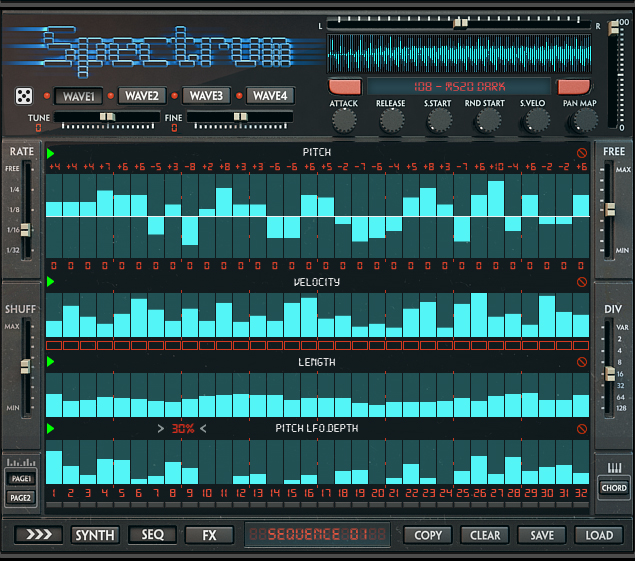
Homegrown Sounds has introduced Orgone & Orgone Lite, VST instruments designed for creating “exotic landscapes, hypnotic rhythms and organic sound.”
Description:
Orgone is suitable for any use, but excels at Pads/Atmospheres and BPM based Rhythmic Sequences. It has a customizable randomize system which makes creating new patches on the fly, an instantly rewarding process.
It consists of 2 identical synth sections which use samples as the sound source, capable of loading any 16/24/32bit WAV files. The WAVs are organised into banks, adding a bank means simply adding a folder of samples which are then accessible via the GUI. The WAVs internal loop points are used by default, though custom loops can easily be visually selected via the loop tuner. Other features of the synth sections include drive, noise, lofi and normalize.
Orgone has a large selection of BPM synced Rhythmic options which includes 2 Modulation Sequencers, an Arpeggiator/Note Sequencer, a Trancegate and a programmable Gapper. The modulation sequencers are used via the extensive modulation matrix to send to any destination, and additionally the polyphonic Sequencer can be used to directly send to the Pitch of either Synth. The Arpeggiator has the usual options plus the ability to mute slots and act as a Note Sequencer.
Microtuning
The fully featured Microtuner works directly with scala files, opening up the scala database of 3500+ tuning files for use within Orgone, plus a large selection of interesting tunings are also included as standard. There are several different layout options for how the notes are mapped across the keyboard, as well as Hz tuning, root note adjust, and octave stretch settings for emulating acoustic instruments. The Microtuner can be switched on per Synth which opens up the possibility of layering Equal Temperement with the selected microtonal patch, which is especially interesting when using a 12 tone scale such as Meantone or Just tuning.
Effects
The FX section plays a large role in creating the sounds and contains Reverb, Organic, Stereo Delay, Echo, Flanger, LFO Filter, Clipper, Ring Modulator and an 8 Band EQ. Organic is a unique effect great used in conjunction with the flanger for creating Organic Pads. Each Synth Section has an independent FX send allowing varying amounts of effect per synth section. There is also a custom FX Routing system which allows 127 different routing combinations as well as Parallel Mode. Any possible combination can be selected which can drastically change the sound of the FX, creating a huge amount of sonic possibilities.
Randomization Options
Orgone has advanced randomization options, every section has its own randomization button, and additionally there is a Master randomize button as well as an FX randomize button. There is a randomization mixer panel which controls which sections these buttons will affect giving fine control over random patch creation. Every randomizable parameter has been carefully selected and limited to a useful range to maximize the possibility of a useful patch. For every Randomize button there is also a default which will reset that section to its default settings, as well as a Master default which will reset most sections back to their default state. Read more…
Send to a Friend
|
Feed for this Entry |
Filed under: Software Synthesizers & Samplers, Virtual Instruments
Ninecows has released The Putney v2.0 (.zip download link), a freeware architectural replica (SynthEdit) of the EMS Putney. The plug-in runs as a VST effect, not a VST instrument.
Description:
As the original it is constructed of basic modules connected in a matrix, letting you route sources and control voltages to different destinations. Many module based synths can do that, but the Putney has one remarkable difference: There is no clear distinction between audio and control voltages as sources. For instance; you can let the output of one audio oscillator control the frequency of another, or use the noise generator to control the filters cut-off frequency.
Even though the synth (just as the original) is monophonic, the flexible routing system will let you create a huge variety of different sounds and effects.
Features:
- Oscilators – Osc 1: Triangle and Sinus shaped wave, Osc 2 & Osc 3: Triangle and Square shaped wave (Osc 3 operates in an approximately 20 times lower frequency range, useful for LFO).
- Noise generator – produces white noise, which is passed through a filter letting you change the colour of the noise with the colour knob.
- Filter/Oscillator – signals assigned to the Filter column of the matrix will be summed and send to the filter.
- Envelope generator – Attack, On, Decay and Off.
- Trapezoid – control voltage produced by the envelope generator is duplicated and send to the trapezoid module where it can be modified further by adjusting its level or adding/subtracting a DC voltage.
- Effects – Ring modulator, Reverberation (spring reverb), Delay.
- Output channels – VU meters and tuner which enables you to tune the oscillators to the standard 440 Hz tuning.
- The Matrix – Route sources and desitination (also inverting signals).
The Virtual Putney looks nothing at all like a real Putney. If you’ve got one, let me know if it sounds at all like a Putney!
via Rekkerd
Applied Acoustics Systems has updated its entire product line for compatibility with OS X.
Their entire product line: Tassman 4, Lounge Lizard EP-2, Ultra Analog VA-1, and the upcoming String Studio VS-1, is now compatible with Mac OS X 10.4 (Tiger).
An update for registered users is available free of charge from the Applied Acoustics website.