AtomoSynth has introduced the Mochika X7, a semi-modular analog synthesizer that updates the company’s Mochika series with an expanded sequencer, additional sound-shaping capabilities, and revised connectivity.
Designed and assembled by the Peruvian manufacturer, the instrument combines an analog voltage-controlled oscillator with a digitally controlled oscillator, a vactrol filter, an ADSR envelope, an LFO, and a delay that can be modulated by control voltage.
The X7’s sequencer provides 32 steps, nine playback modes, and nonvolatile storage for up to 100 patterns. An 18-point patchbay exposes synthesis and modulation connections for external routing.
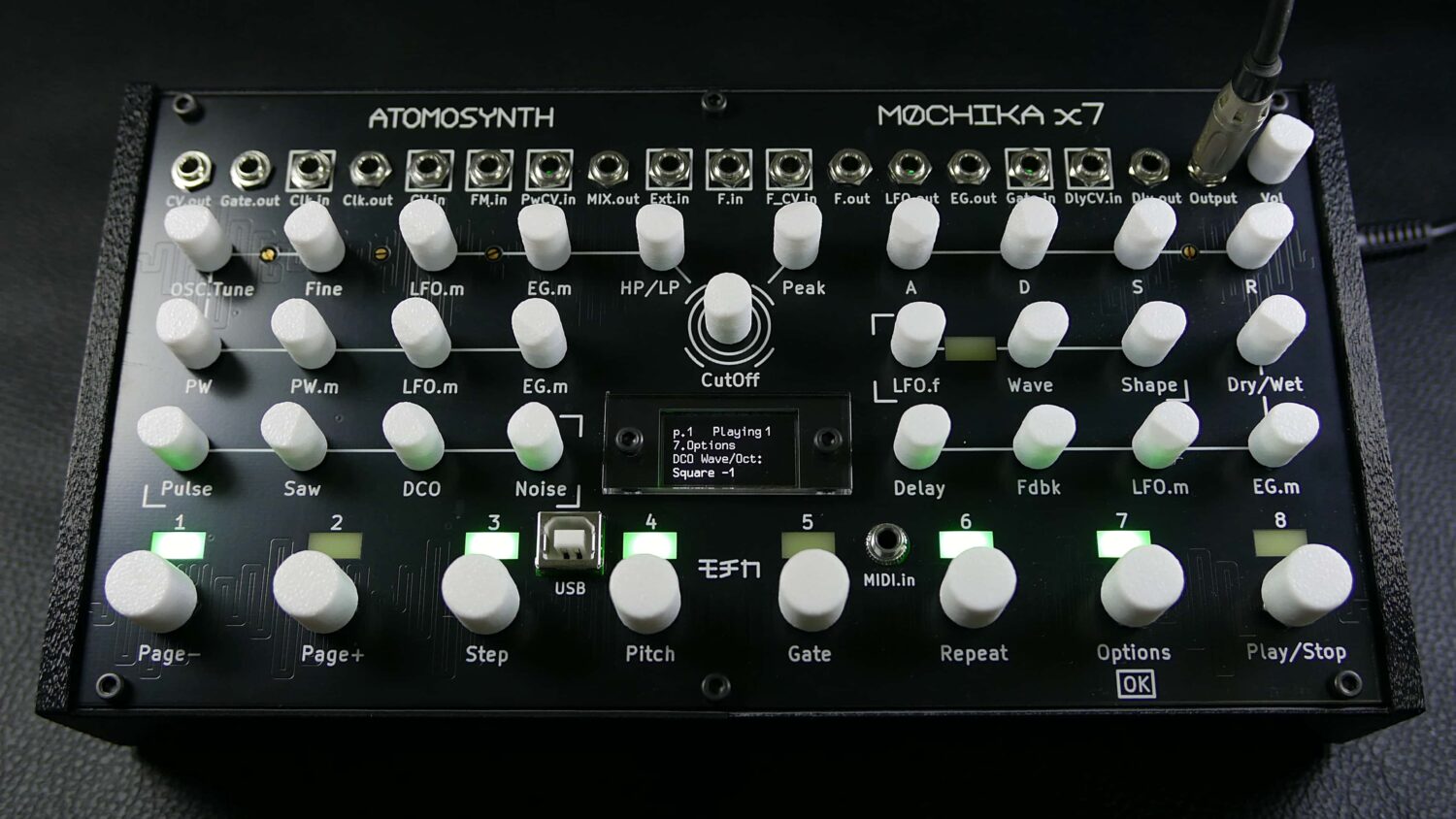
Features:
- Oscillator Architecture: The Mochika X7 combines an analog voltage-controlled oscillator with a digitally controlled oscillator. The VCO provides square and sawtooth waveforms with pulse-width modulation, while the DCO offers square, sawtooth, triangle, and sine waveforms.
- Wave Shaping: The analog oscillator includes pulse-width modulation and a wave-shaping section. The instrument’s oscillator and modulation connections provide additional options for altering the signal through external control-voltage patching.
- Vactrol Filter: The filter provides switchable low-pass and high-pass operation, with continuously adjustable cutoff and resonance. Its vactrol-based design forms a central part of the instrument’s analog signal path.
- Modulation: An ADSR envelope generator and an LFO provide modulation for shaping notes and sequences. The LFO’s waveform can be adjusted continuously between pulse and triangle shapes, with a symmetry control for changing pulse width or ramp slope.
- CV-Modulatable Delay: The X7 adds an onboard delay effect with a control-voltage input, allowing its behavior to be modified through the patchbay and incorporated into external modulation configurations.
- 32-Step Sequencer: The sequencer provides 32 steps, expanding on the 16-step sequencer found in the earlier Mochika X5. Step-level controls include pitch, gate time, retriggering, and repetition or skipping behavior.
- Nine Playback Modes: Sequencer modes include forward, reverse, ping-pong, random, drunk, step-trigger, worm, scrub, and MIDI control. These modes provide different approaches to generating and manipulating repeating patterns.
- Pattern Memory: The instrument stores up to 100 patterns in nonvolatile memory. Sequencer parameters and playback modes can be edited while the sequence is running.
- Clock and MIDI Integration: The internal clock can synchronize with an external clock, MIDI clock, and USB MIDI. External MIDI devices can also be used for note input and sequence transposition.
- Patchbay: An 18-point patchbay provides nine inputs and nine outputs for routing oscillator, filter, delay, and modulation signals. This allows the instrument to function as part of a larger modular or semi-modular setup.
- User Interface: The control panel features a high-contrast OLED display, eight rotary encoders with pushbuttons, and eight step LEDs for editing parameters and interacting with the sequencer.
- Hardware Configurations: The Mochika X7 is planned in two formats: a desktop synthesizer with an enclosure and a 48HP Eurorack module. The desktop configuration uses an external 19V power supply, while the Eurorack version draws power from the modular system.
Pricing & Availability:
The AtomoSynth Mochika X7 is available to preorder for $399 for the desktop version and $349 for the Eurorack module (stanedard prices are $449 and $389, respectively.)
