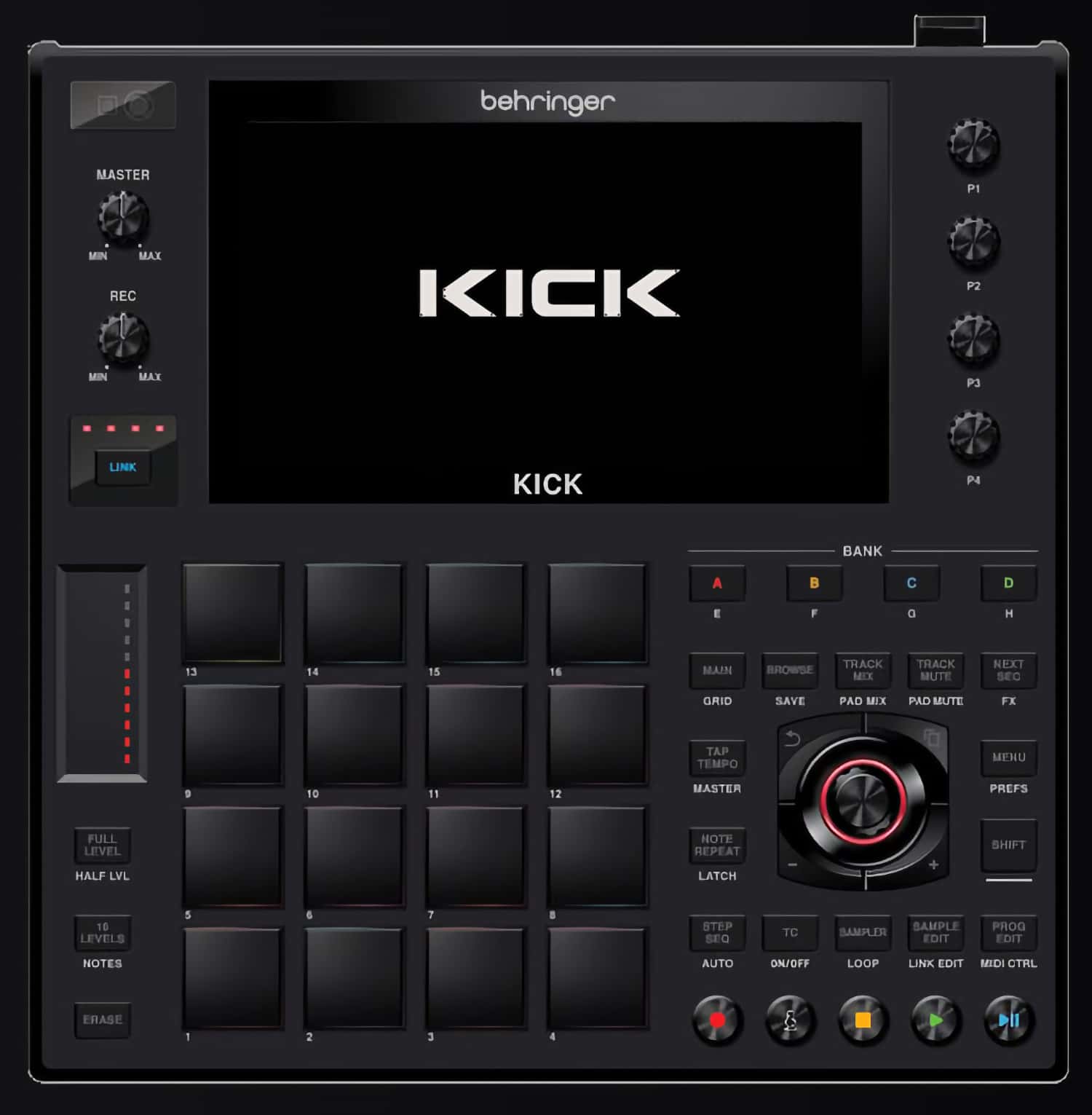
 It looks like Behringer wants to copy the success of the M-Vave FM-1 and its open hardware platform – and the Akai MPC, while their at it.
Music Tribe has published an open-source software repository for the Behringer KICK, a standalone music production center built around sampling, sequencing, and performance controls.
This follows a manifesto of sorts from founder Uli Behringer, who says “The biggest threat to business isn’t AI. It’s abundance.”
He adds that he’s “transferred ownership of Music Tribe to the Uli Behringer Foundation, and we’re pursuing formal nonprofit recognition.”
“I believe the greatest AI revolution won’t be replacing humans. It will be unlocking the creator in every human being.”
To that end, Music Tribe is planning to open ‘selected’ designs, so communities can use AI to create their own firmware, add features, and reinvent products. This sort of community-driven development has already been happening with the FM-1 and other devices.
While there are notable open hardware predecessors – from companies like the Mutable Instruments modules & the Synthstrom Deluge – the Behringer Kick will be the first music device from a major manufacturer designed with this open firmware development model in mind.
The Github repo readme describes the Behringer Kick as a device with a 7-inch touchscreen, 16 RGB pads arranged in eight banks, a sampler with sample editing, a step sequencer, and a looper. Other features include more than 300 built-in effects, four assignable knobs, a jog wheel, and an AI camera for gesture control.
Connectivity includes MIDI In and Out, USB-A and USB-C, stereo audio inputs and outputs, an SD card slot, and four CV/Gate jacks for integration with synthesizers and modular equipment.
The project includes source code for the KICK application, its AudIO audio engine, and the hardware communication protocol, along with a Linux build system. The application, audio engine, and communication protocol are published under the GNU Affero General Public License.
Uli Behringer’s manifesto – along with his non-profit organization and venture into open software – promises to bring another major disruption to the music industry’s status quo.
Availability:
The Behringer Kick source code is publicly available on GitHub. No confirmed retail price or shipping date for the hardware has been announced.
What do you think about Behringer’s announcement? Share your thoughts in the comments!

The success of this all depends on how powerful it’ll be.
If it’s able to natively run multiple instances of VST’s then it should be a hit.
The days of ‘Built in Obsolescence’ are numbered.
Open source brings innovation.
Yes and no… Obsolescence will still be around for a while, I’m afraid.
In desktop computers, you have been able to freely swap parts for ages and yet technologically every year or couple of years, a new technology or feature appears that leaves you out of the game.
The thing is you will be more free to take advantage of the hardware you own, and you will certainly get the most out of it, whether the original manufacturer allows you to or not.
this is known as “reading the room”
Just the other day people were laughing at me for saying this kind of unlocked hardware platform was the future, yet here we are. An MPC One clone wouldn’t have been my first choice and I could type out a list of things I don’t like about it; I also wonder if they’ll face litigation for copying Akai’s design language so closely, for which I assume Inmusic has patent protection. But that’s Behringer’s business choice and maybe they have their strategic reasons.
Legal questions aside, this will likely be a winner. Behringer has demonstrated their manufacturing ability repeatedly and there isn’t anything here that they haven’t done several times before (eg the pads and the screen have appeared on drum machines and digital mixers before). The computer brain part is just a system-on-a-chip on a commodity board (as is the MPC). It won’t be anything spectacular – probably an ARM Cortex with 4gb ram. But like the panel hardware it will be Good Enough to meet most people’s needs. I guess it’ll cost around $400, similar to their Linn and Oberheim drum machine emulations.
A (very) quick glance at the firmware suggests it’s a rework of some sort of minimal Linux DAW, maybe an old build of Audacity or suchlike. It will probably be a bit underwhelming, but there’s a huge library of open JUCE plugins and there are JUCE wrappers for VST2s, so there won’t be any shortage of sound/FX modules. What will be be really interesting is to see what people do with the sequencing side. I expect a lot of people will maintain a basic ‘tape recorder’ type linear sequencer, but instead of going for the ‘DAW in a box’ approach of the MPC series we might see a lot of nonlinear/programmable/groove sequencers as on the VCV platform.
Exciting times. I’m a long-time MPC user and I doubt that will change any time soon (not least because I’m too lazy to port my MPC projects to a different platform) but having unlimited software access to a computing platform with adequate audio hardware and decent front panel controls backed by a big company’s manufacturing economies and expertise (vs any of many plucky crowd-funded projects) is going to upend the music production market.