Past To Future Plugins has released PTF 224 White Reverb, a software recreation of the Lexicon 224 digital reverberator, introduced in the late 1970s.
The original 224 is probably best known to synthesists as the ‘Vangelis reverb’ – as heard on the Blade Runner soundtrack.
The plugin models the original unit’s signal path, including its input filtering, digital conversion characteristics, and network of eight delay lines used to generate reverberation.
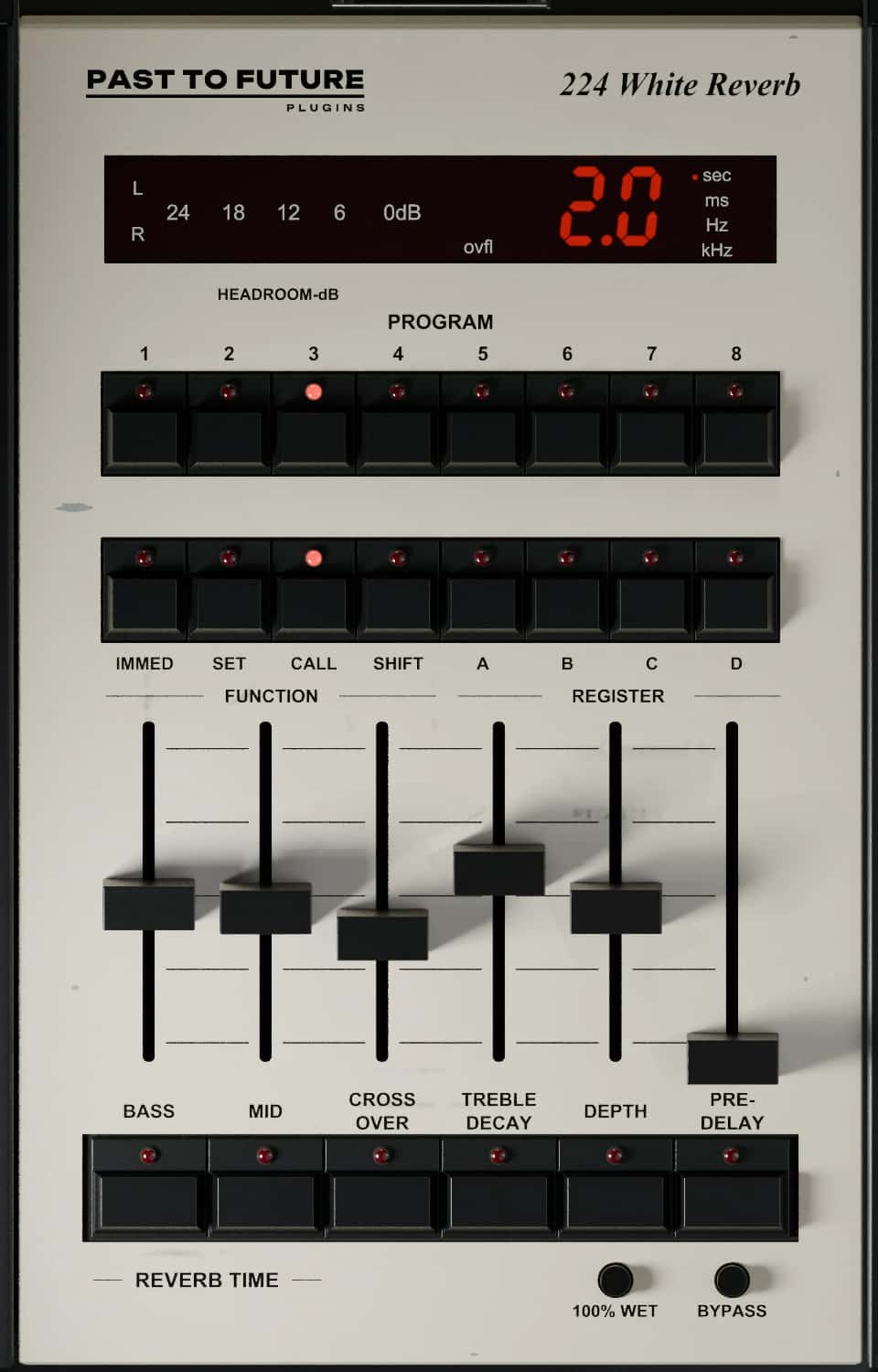
The software includes nine programs, independently adjustable bass and midrange decay times, and a virtual version of the original white remote control. It also offers a choice between a three-dimensional representation of the hardware controller and a traditional flat-panel interface.
 Features:
- Lexicon 224 Emulation: PTF 224 White Reverb recreates the signal path of the classic digital reverberator, using impulse-response measurements taken from an original hardware unit to guide its reverb programs.
- Nine Programs: The plugin includes two small concert halls, one large concert hall, a vocal plate, an acoustic chamber, a percussion plate, a constant-density plate, a room, and Chorus A.
- Hardware-Matched Decay: The eight reverb programs match the sampled hardware’s decay times within 8% across seven octave bands from 125 Hz to 8 kHz, with an average deviation of 2.2%.
- Vintage Digital Conversion: The processing engine recreates the original unit’s 12-bit mantissa and 2-bit exponent conversion characteristics, alongside an eighth-order input filter operating at approximately 8.1 kHz. These features reproduce the bandwidth and signal-dependent noise behavior associated with the original hardware.
- Independent Reverb Times: Bass and midrange decay times can be adjusted separately, with a crossover control determining the frequency boundary between them. Reverb times range from 0.6 to 70 seconds.
- Additional Reverb Controls: Treble Decay adjusts the high-frequency decay, while Depth controls the relationship between the early reflections and the reverberation tank. Pre-delay can be adjusted up to 255 milliseconds.
- Extended Parameters: A secondary control page provides access to mix, input and output levels, bandwidth, mode enhancement, and decay optimization, allowing users to modify the emulation beyond its original operating settings.
- White Remote Interface: The plugin recreates the original controller’s program buttons, CALL, IMMED, SET, and SHIFT functions, four registers, and six sliders. Users can choose a detailed 3D-rendered interface or a classic flat-panel appearance.
- Preset Management: The software includes 42 factory presets across six banks. Four registers can store custom control configurations with the DAW session, while additional presets can be saved as files.
- Audio Routing: PTF 224 White Reverb supports stereo input and output, as well as mono input to stereo output. Wet/dry mix and bypass controls are included for integration into mixing and sound-design workflows.
Pricing & Availability:
PTF 224 White Reverb is available now for macOS and Windows. The introductory price is €62, reduced from the regular €80 price. A 7-day trial version is also available.

Unless it’s algorithmic, which it isn’t, then it definitely seems very overpriced for a custom-IR processor.