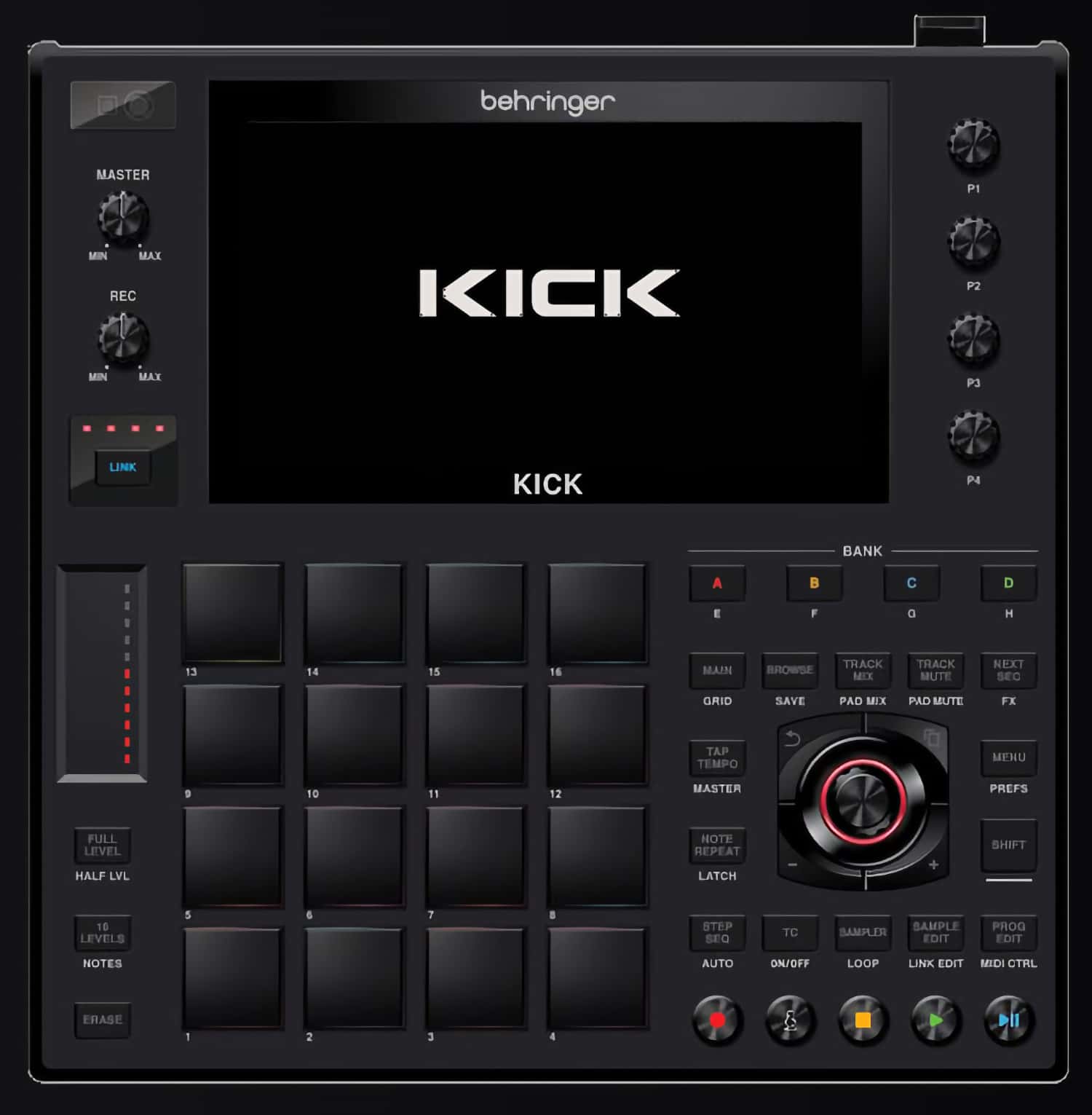
 It looks like Behringer wants to copy the success of the M-Vave FM-1 and its open hardware platform – and the Akai MPC, while their at it.
Music Tribe has published an open-source software repository for the Behringer KICK, a standalone music production center built around sampling, sequencing, and performance controls.
This follows a manifesto of sorts from founder Uli Behringer, who says “The biggest threat to business isn’t AI. It’s abundance.”
He adds that he’s “transferred ownership of Music Tribe to the Uli Behringer Foundation, and we’re pursuing formal nonprofit recognition.”
“I believe the greatest AI revolution won’t be replacing humans. It will be unlocking the creator in every human being.”
To that end, Music Tribe is planning to open ‘selected’ designs, so communities can use AI to create their own firmware, add features, and reinvent products. This sort of community-driven development has already been happening with the FM-1 and other devices.
While there are notable open hardware predecessors – from companies like the Mutable Instruments modules & the Synthstrom Deluge – the Behringer Kick will be the first music device from a major manufacturer designed with this open firmware development model in mind.
The Github repo readme describes the Behringer Kick as a device with a 7-inch touchscreen, 16 RGB pads arranged in eight banks, a sampler with sample editing, a step sequencer, and a looper. Other features include more than 300 built-in effects, four assignable knobs, a jog wheel, and an AI camera for gesture control.
Connectivity includes MIDI In and Out, USB-A and USB-C, stereo audio inputs and outputs, an SD card slot, and four CV/Gate jacks for integration with synthesizers and modular equipment.
The project includes source code for the KICK application, its AudIO audio engine, and the hardware communication protocol, along with a Linux build system. The application, audio engine, and communication protocol are published under the GNU Affero General Public License.
Uli Behringer’s manifesto – along with his non-profit organization and venture into open software – promises to bring another major disruption to the music industry’s status quo.
Availability:
The Behringer Kick source code is publicly available on GitHub. Behringer says that it’s targeting a retail price of $150 USD for the Kick. No confirmed shipping date for the hardware has been announced.
What do you think about Behringer’s announcement? Share your thoughts in the comments!

The success of this all depends on how powerful it’ll be.
If it’s able to natively run multiple instances of VST’s then it should be a hit.
Uli has mentioned (on facebook I think, I don’t use it so this is second hand) that it will be an RK3588-based device, which should be powerful enough. Particularly keeping an eye on how quickly the FM-1 firmwares have been optimized, if that follows over then it should be a good platform.
Doesn’t really do it for me but it’ll be really interesting to see what people do with it (and what people port over).
The days of ‘Built in Obsolescence’ are numbered.
Open source brings innovation.
Yes and no… Obsolescence will still be around for a while, I’m afraid.
In desktop computers, you have been able to freely swap parts for ages and yet technologically every year or couple of years, a new technology or feature appears that leaves you out of the game.
The thing is you will be more free to take advantage of the hardware you own, and you will certainly get the most out of it, whether the original manufacturer allows you to or not.
that is OS based though. having FW on a device vs an OS on a computer is a different level of control and usefulness – you basically have 3 OS’s on a desktop computer. windows, macOS and different flavors of linux, all of those create there own levels of obsolescence based on closed source products (outside of linux, though it has varying levels of hardware support and cross functionality)
this is known as “reading the room”
Just the other day people were laughing at me for saying this kind of unlocked hardware platform was the future, yet here we are. An MPC One clone wouldn’t have been my first choice and I could type out a list of things I don’t like about it; I also wonder if they’ll face litigation for copying Akai’s design language so closely, for which I assume Inmusic has patent protection. But that’s Behringer’s business choice and maybe they have their strategic reasons.
Legal questions aside, this will likely be a winner. Behringer has demonstrated their manufacturing ability repeatedly and there isn’t anything here that they haven’t done several times before (eg the pads and the screen have appeared on drum machines and digital mixers before). The computer brain part is just a system-on-a-chip on a commodity board (as is the MPC). It won’t be anything spectacular – probably an ARM Cortex with 4gb ram. But like the panel hardware it will be Good Enough to meet most people’s needs. I guess it’ll cost around $400, similar to their Linn and Oberheim drum machine emulations.
A (very) quick glance at the firmware suggests it’s a rework of some sort of minimal Linux DAW, maybe an old build of Audacity or suchlike. It will probably be a bit underwhelming, but there’s a huge library of open JUCE plugins and there are JUCE wrappers for VST2s, so there won’t be any shortage of sound/FX modules. What will be be really interesting is to see what people do with the sequencing side. I expect a lot of people will maintain a basic ‘tape recorder’ type linear sequencer, but instead of going for the ‘DAW in a box’ approach of the MPC series we might see a lot of nonlinear/programmable/groove sequencers as on the VCV platform.
Exciting times. I’m a long-time MPC user and I doubt that will change any time soon (not least because I’m too lazy to port my MPC projects to a different platform) but having unlimited software access to a computing platform with adequate audio hardware and decent front panel controls backed by a big company’s manufacturing economies and expertise (vs any of many plucky crowd-funded projects) is going to upend the music production market.
super astute and measured assessment here. thanks for your insight @ anig
agree on all counts. this isn’t for me, but it’s a very interesting and likely ultimately positive development.
i do find the tidbits quoted from Uli quite strange and a bit off-putting but whatever. that’s neither here nor there.
Believe me, I hope you’re right. I’ve been looking for a ready to use groovebox with an open source firmware for ages. Or at the very least, a commercial groovebox that had an open source firmware option that could be improved on. There are so many features that’d be easy enough to add, even without AI coding, if there was a base to work from.
I’ve tried a lot of devices that were basically an MCU and a DAC like the CardPuter ADV. I hope the KICK materializes, and I hope
Behringer have launched a project that people will brick with their custom firmware updates and have to buy another one, maybe two or three.. also- software licensing? what license. its custom firmware mate.
Has anybody really bricked their synth with a firmware update?
If that’s a thing, that’s a flaw with the hardware, not the firmware. No firmware should brick your gear.
I bricked a synth somehow, just wouldnt start ip one day, i did a fireware update that unbricked it it was a virus rack the red one,
Bricked means damaged for life unusable forever! Your was temporarly out of order thats a big difference!
Or….the need of replacing one chip and then you are good to go?
Unclear on the concept
Any firmware-based device could crash on startup if you pull out a USB or midi cable or power cycle in the middle of updating it. That’s why there’s always a special button combination you can hold down on startup to force a complete reset/safe boot/diagnostic mode. The manufacturer doesn’t always advertise it because they don’t want to deal with support headaches, but it’s always there and if that doesn’t work (eg because the front panel is amaged) there’s usually an additional switch internally. This is true of the MPCs for instance.
Anyone buying this device is going to understand it’s a specilizaed computer and that they’ll have to IDY things instead of having them done by the manufacturer. So the very first thing they’ll learn is how to reset it if it crashes. Thinking that they’re going to need to buy new units following a crash just tells me you don’t understand how to fix a problem with your computer or phone. This product is not for you.
Offical Behringer account on FB says target retail price around $150.
I estimated $400 earlier today. If they’re going that low this is a really aggressive move.
HE WAS KICKED OUT OF A MUSIC STORE BECAUSE HE COULDN’T AFFORD ANYTHING.
That young musician was Uli Behringer.
That experience inspired a mission: Democratize music technology and empower those who have not and cannot.
Nearly 40 years later, we’re taking that mission to another level.
? INTRODUCING BEHRINGER KICK — OUR FIRST OPEN-SOURCE HARDWARE SAMPLER!
Target retail price: around US$150.
But this is about much more than affordability.
We’re opening up our hardware and software so anyone can create, modify and reinvent what an instrument can do.
With AI, even people without programming experience can turn their ideas into new features and firmware.
We build the hardware. YOU create the possibilities.
Imagine millions of creators innovating together instead of a handful of engineers behind closed doors.
KICK is just the beginning. More open platforms will follow shortly. Stay tuned.
Because there is a creator in every human being.
? KICK Source Code:
https://github.com/MusicTribeOpenSource/0700-AAM
? All Open-Source Projects:
https://github.com/MusicTribeOpenSource
? Join Our Discord:
https://discord.gg/gS6qtuShvw
What would YOU create with KICK?
Built by Behringer. Reimagined by everyone.
#Behringer #OpenSource #KICK See less
Uli Behringer is the pioneer of vibe-coded hardware slop.
“HE WAS KICKED OUT OF A MUSIC STORE BECAUSE HE COULDN’T AFFORD ANYTHING.
That young musician was Uli Behringer.”
I call BS.
Regarding the last 2 words of that mess: I wish I could.
thx for the info.
Looks great the only thing I would change make another set of 4 knobs on the left. So that you have 8 macros not only 4. I think thats really really important!
Checking the firmware firmware,hub it’s up to 104 unique firmware in a little under a month
There are already some lofi samplers..it wouldn’t surprise me if the fm1 gets some style of mpc sequencer, probably before behringer release the kick.
I think behringer is having a lot of difficulty releasing their synths. Or wait I’ll use industry language..behringer is releasing in boutique batches.. ie small numbers.
“behringer is releasing in boutique batches”
on what planet do you life?
I’m on planet ill believe it when it ships.
Until then it’s ai vaporware
AKAI have already caved and are open sourcing an upcoming device.
Exciting times.
Hopefully TVs, PCs, Phones about to go the same way.
Has anyone else notice how weird this device and press release quotes are? No musical instrument should have an AI camera built into it, especially when it’s leaning into the open source, vibe coding flavour of the day. Who wants their gear turned into surveillance equipment?
Then there’s a real lack of self awareness from Uli Behringer: “The biggest threat to business isn’t AI. It’s abundance.”
Offloading a press release to ChatGPT will lead to the cliche ‘it’s not X, it’s Y’, but isn’t the point it made antithetical to Behringer’s business model?
I think the AI camera could be quite fun.
It could be used like Roland’s “D-Beam” and assigned to modulate parameters via gestures.
If you’re concerned about “surveillance”, well then just code the camera to be always off. Problem solved.
Yeah, nah with all due respect. Gear with obvious security flaws shouldn’t be made & it shouldn’t be on the user to attempt to make sure their hobbies aren’t spying on them. A safer solution than attempting to disable the camera is to not buy it.
I’ve got a grimy old SP606 & can vouch for the D-beam being little more than a gimmick. It’s fun for pretending to be a wizard few minutes but that’s about it.
I prefer to pay 1000$ for a “limited” elektron device than this piece of shit 😀
“Free labor, you say?” (adjusts monocle)
btw, Behringer haters…. your tears are sweet like wine
wavetable & granular shenanigans & convolution & cv tools seem like the obvious things to do … 🙂
this could beat the shit out of my ipad, wow.
this will be the end of music software on iPad ^^
dedicated hardware that runs whatever you dream up as software
for under 200€
fasten your seatbelts
. No problem with this….zero. The brand and I go way back when I was truly penny pinching. These days, the brand is leaps and bounds beyond expectations.
I support vibe coded firmware as much as I hope software engineers support prompted music. GenAI is GenAI
Um….This might be good or bad, For future references, I don’t want to feel like a programmer.. creating codes and what not.. I just want to load up my software, my mixer, hit record that’s it… It starts to interfere with the creative process , maybe I’m wrong maybe I’m not. Maybe if I get bored I’ll create codes.
I was told to “Get Lost” by a sales guy at Whitmer-McNease music when I was 16 and could not afford anything. Returned in my 20’s when I could, but there wasn’t anything I wanted to buy. When they went out of business. I returned at night to visit the store in person, to gloat about how I didn’t need them anymore. To hell with gatekeepers. Music is for everyone.