Polyend has introduced Keys: the first mechanical QWERTY keyboard that’s designed for music.
The Polyend Keys features a three-octave piano layout, that’s designed for both everyday computer use and making music.

Keys works as a regular computer keyboard or a MIDI controller, with the number row and function keys arranged as a three-octave piano keyboard. The same keyboard you use to type can be used to play notes, record melodies, or control an external instrument.
Nine rotary controls can be freely assigned to MIDI CCs for controlling parameters in a DAW or hardware instrument. They can also be assigned to everyday computer functions such as volume, scrolling, and brightness.
An integrated display provides feedback for the controls and can be used by different applications and future features. A TRS MIDI output lets Keys connect directly to a synthesizer, drum machine, or other MIDI hardware. With its built-in rechargeable battery, Keys can be also used as a standalone MIDI controller without a computer.
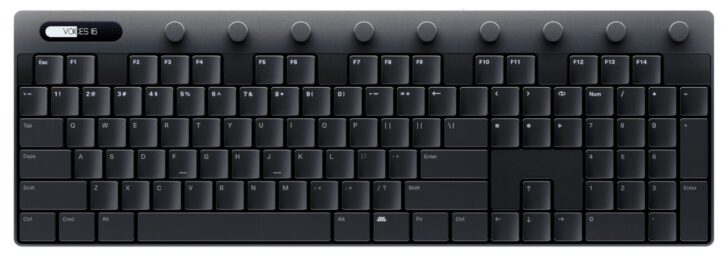
Keys is a low-profile mechanical keyboard, machined from a single piece of aluminum. It uses hot-swappable Kailh low-profile switches, so individual switches can be changed without soldering. The keys are backlit, and Keys can connect wirelessly over Bluetooth or wired via USB.
Keys is also open source. The software can be expanded beyond the functions it ships with, opening the door to alternative layouts, new control modes, custom MIDI controllers, sequencers, and other applications.
Features:
- Mechanical QWERTY keyboard
- Three-octave piano keyboard
- Machined aluminum unibody
- Hot-swappable Kailh low-profile switches
- Typing and MIDI modes
- Built-in screen
- 9 freely assignable MIDI CC controls
- Integrated display
- TRS MIDI output
- USB and Bluetooth connectivity
- Built-in rechargeable battery
- Backlit keys
- Open source hardware
Pricing and availability:
Polyend is introducing Keys publicly for the first time this week at Gamescom in Cologne from August 26–30.
Details on pricing and availability are still to be announced. Colors, specs, and price are subject to change.

This is exactly what I always wanted for my trackers. Can’t wait! Would be nice if they make it split keyboard though.
I’m gonna play the devil’s advocate here:
Who is this intended for? Who’s the target group?
Those who us who own a MIDI keyboard or keyboard synthesizer are covered.
Those who don’t, probably don’t know how to play anyway.
I’m using the qwerty keyboard to input notes in Bitwig. Before that, in Ableton live. I used to have regular midi keyboards and I made good use of them without knowing how to play. But it never felt ideal to me to reach for a separate keyboard from the computer keyboard so this somewhat solves that. Also, getting used to working with a laptop keyboard has its advantages when it comes to mobility.
I guess whoever doesn’t use their QWERTY keyboard for inputting notes won’t get it, but judging by the amount of comments on youtube, it seems like there are a lot of people who are interested.
Tracker geeks
I think the gamescon launch is the giveaway. Some of their devs probably wanted a scriptable, open-source keyboard to game on and realized there’s not that many options out there. The MIDI thing feels like an afterthought, but a scriptable, open-source keyboard where anything can be mapped to anything else, remembers all the mappings internally, and has some knobs and a screen, yeah, I can see a market for that. Like, enterprise-level solutions where now you don’t have to ship a separate knob controller for a venue or instrumentation? Great. Not a great volume product for home studios probably, but I think it’s got a solid niche market.
There are tons of open source, easy to customize, keyboards. You can even make QMK keyboards send MIDI and MIDO CC as well. The stock firmware on this should be quicker to set up I guess.
Most likely for users of Renoise and other trackers.
I love working with a mouse and keyboard – only thing i miss sometimes is a few potmeters. My Push 2 was collecting dust on my desk and eventually on my shelf before selling it. I’ll get one if they don’t go crazy with the pricing.
Any electronic musician who travels and might want to perform live without taking a bunch of studio hardware with them. No velocity sensitivity is a headache for some but for many not that big of a deal. I have 4 hardware synth/sequencers that are not velocity-sensitive.
One obvious target market: people who make music with iPads and other tablets.
Sure thing.
I’m not trying to be mean or nasty or anything, I just can’t see a big market potential for it.
Niche: Sure.
Something that wil make people stand for hours in line: No (hyperbole, of course).
color me surprised if this does not cost similar to said ipad or tablet. well made scriptable keyboards run ~300 or so and are still mostly plastic, and don’t have knobs or screens. This is probably 500+
would you like to play chords on your typing keyboard?!?
no thanks, the iPad does a much better job here. 😉
If my current keyboard broke, I’d at least consider this.
2nd that, next time I’m on the market for a typing keyboard this is going to be top of the list.
I’ve had a similar idea ever since I first saw the Wooting 5–6 years ago, but I wanted to base mine on analog mechanical keyboard switches, with something that interprets the key presses as velocity/pressure and supports MPE/PolyAT.
I was also thinking about using an isomorphic keyboard layout that takes advantage of the number of keys, with color coding to represent the scales and allow for more than 3 octaves.
But unfortunately, these keyboard keys seem to be regular mechanical ones, so for me it’s mostly just a regular keyboard with a controller on top.
I have my Minifreak between my Magic Keyboard/Magic Trackpad and my computer monitor
That works very well.
The keyboard and trackpad together are EXACTLY as wide as the ‘freak. I assume that is not a coincidence.
It’s for those that want to jam away while being stuck at the office. No one will ever know…
Didn’t creative labs create the same thing 20 years ago that flopped because its just dumb?
I have to second this motion here, I remember more than one attempt at this kind of thing, including itty bitty synth keys underneath the space bar area.
This is where necessity is not the mother of this invention.
I mean, it’s clever, and all that, but… as someone else said, I really don’t know who this is for, unless someone wants to go stealth in the cubicle.
And even then, both Logic and Ableton have menu commands to make your keys become keys, if you catch my drift.
I wish them luck in this venture, though!
the creative labs prodikeys was big though, this thing seems to be on par with a 96% mechanical keyboard
my first thought was friends that like to use trackers, but a second later my mind went to how they have muscle memory and this change wouldn’t benefit a seasoned tracker musician like that. it is niche but i could see someone with experience on a traditional piano style keyboard interface maybe going for this if they were getting into virtual instruments and had limited space, though they would probably detest the mini keys and low octave range
Did you know that roughly 10 years before Apple started to sell iPads, that Microsoft tried to sell tablets? It seemed to be a bad idea in 2000, but apparently not so much in 2010.
Music software has obviously evolved in 20 years, and so have the things people do to make music with them. Times have changed.
I think it’s a great idea, whether they execute it well is yet to be seen.
a bit strange to first introduce a QWERTY keyboard in a country that uses QWERTZ keyboards.
It’s the most commonly used keyboard layout worldwide. Also, the keys are swappable, so you can easily change it yourself.
who wants to write on a qwerty keyboard without ö,ä,ü,ß?
(or whatever your native language has to offer …)
localized keyboards rule 😉
greetings from Germany
good luck with swapped & reprogrammed keyboard buttons, it will be nightmare to use 😉
oh oh application doesn’t recognize this key, hihi, no thanks.
This actually looks pretty awesome. If it’s not too expensive, it will be a must buy for a lot of us.
Must buy? I doubt that 🙂
I don’t think this is dumb at all. One of my workspaces is small, with my keyboard perpendicular and to the left of my monitor….space issues. With this keyboard, I could be working with my DAW without constantly turning back and forth. I am intrigued.
Depending on the price, I can see how this would be real useful for in the box use.
I’m calling it now, they are going to charge an astronomical price for this, support it for a year or two, then just drop support swiftly and suddenly end support. Don’t believe me? Go to their website and look at their “Legacy” products. It is growing quickly. when the Seq released it was over $1200. they released a few firmware updates and dropped it. Be weary of Polyend.
It’s very well built, noble material (aluminum) and very cool to look at BUT no velocity sensitive.
That’s a deal breaker for me.
Maybe the mk2?
Is there a way how to do it and still be able to type though?
yes. Hall effect switches and Tunnel Magnetoresistance switches are a thing already.
Found this from the moderator on Polyend’s forum:
“Pressure sensitivity as well as aftertouch is in development. We will likely use solution similar to TE KO2 pressure sensitive film under mechanical switches.“
Ten Keyless 2-octave version, please. If you’re terribly cramped for space, you need something truly compact. If you’re not terribly cramped for space, you’ll at least find a way to facilitate a mini-key keyboard on the desk.
Brilliant idea, worried about the pricing.
I wonder if that button between alt and fn is the way you switch between QWERTY and MIDI?
Also wonder, presuming they’re different modes, if the qwerty keys can be used to send MIDI messages (when in MIDI mode).
Honestly, I was hoping it would have some sort of velocity sensitivity, if it did I’d be sold.
It’s polyend, it has a screen and therefore firmware. So it’s most likely for the first couple of years about as reliable as a horse with a hole in it.
Having had a Medusa, tracker, tracker mini. I wouldn’t touch any poly end product again due to the near alpha release level of firmware until v3 releases at least.
Sorry guys, but I probably would like to successfully type my returns email on it but I expect no dice and I would end up lumbered with a keyboard shaped doorstop.
It not really complex in terms of software compared to the the other products you mentioned.
Why would you offer a keyboard without localized versions?
This makes no sense at all.
If you don’t want to open that can of worms, don’t do a keyboard because it won’t sell like sliced bread. 😉
They’re a small company, I’m pretty sure they can’t afford all the different types of keyboard layouts on such an experimental idea (hardware is expensive!). They’re probably trying out the idea and if it goes well and they don’t actually lose money from it, my guess is there’ll be a mkII eventually.
Besides, “Hot-swappable Kailh low-profile switches” and “Typing and MIDI modes” sounds like you can already swap your favorite keys and config the layout in your OS.
im getting the keyboard horror already when I have to use a windows keyboard because the “@” isn’t on the “L” ^^
good luck with selling this one ^^
I really like the idea but feel it’s could’ve been more extreme. The location of the note keys seems a bit cumbersome as your palms will rest on the keyboard keys while playing, or need to hover over them. Having that said its a good looking object and a great niche to explore.
https://youtu.be/Ofn2A1p13Sg?si=OPeQNIbrpU7f2urv
20 years earlier.
Bummer it isn’t velocity sensitive!
I’ve been playing with the idea of a keyboard like this, but with velocity sensitivity, using hall effect keys. Some hall effect key switches can provide velocity through an API. Having the rotary encoders is pretty sweet!
I cut my teeth on making music using FastTracker ][ in the 90s. I’ve still got a lot of muscle memory for playing keys on a PC keyboard – q will always be C4 in my heart.