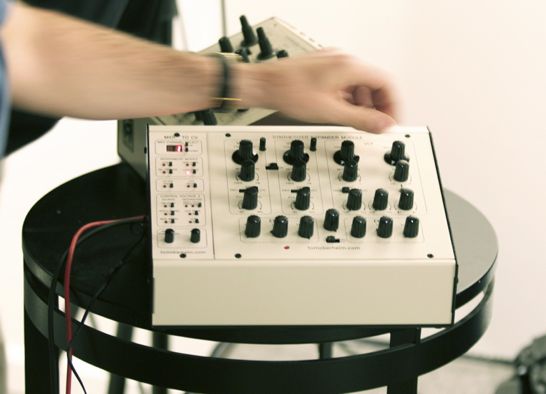
Synth pioneer Tom Oberheim introduced a new version of his Oberheim SEM synthesizer at the Red Bull Music Academy presentation in Boston on June 3, 2009.
The original Oberheim SEM (Synthesizer Expander Module) is a classic bit of gear that’s best known for its unique 12dB/Octave filter.
Matthew Davidson (stretta) has some great images from the event of the new synth up on flickr.
Here’s an edited version of Oberheim’s introduction, again via Matthew Davidson. Tom discusses the changes made to the new SEM and the reasons behind them, pricing, and demos a few sounds:
Full details and pricing it to come.
It looks like Oberheim is joining fellow synth pioneers Bob Moog and Don Buchla in revisiting his classic creations. Think it will be hit, too?
Leave a comment with your thoughts on the new Oberheim SEM!

This looks so much like the old SEM!
I can't see this being big like the new Minimoogs, though. Too esoteric!
^ There's been more than a few occasions this was due to the playback and amplification hardware, or format limitations. I'd like to see more rigorous tests to substantiate this, because like high-bitrate MP3s vs. lossless WAVs or even sampled pianos vs. acoustic pianos, I suspect less people can tell the difference than they actually claim to. All-too-often, what's missing is "Who does this benefit? Make a difference for?"
And over time, given the proliferation of new technology, the newer stuff becomes what's broadly preferred. That's not due to its sonic quality being inherently better, but what listeners are familiar and comfortable with. (Not unlike how Western ears find microtonal scales strangely dissonant, and polyrhythms are considered "exotic".)
That being said, most arguments about analogue vs. virtual analogue are useless, because they fail to mutually consider the intentions and desires of the conflicting musicians involved. I prefer an AND approach: I'll use soft synths for their convenience, but if I find I'm not getting the sound I want "within the computer", I'll seek out an antique, sample it, then perhaps hybridize it further. That's what I want to do, and each of us has our own goals of self-expression.
those who say they cannot tell the difference can be happy with hardware, as an doctor of audiology and a synthesizer enthusiast I can both explain… but why bother, and personally tell the difference.
If you are happy with software then be happy. If you're more satisfied with hardware, then be happy. This is Tom's hardware synth… and it's a beautiful synth.
So leave it at that.
I'll get one… you can buy a new VST and we can both be happy.
Steve
LOL… my first sentence makes no sense.
I meant to say… those who cannot tell the difference between hardware and software can be happy with software. Those of us who can tell the difference will prefer the hardware.
🙂
Peace… and just make music
have fun
Not to be able to hear the difference between soft and Analog and why analog is so much pleasant to the ears is not a bliss is an illness.
To the ones who love soft I'll say .. stay with soft , it's cheap, it takes no space and you like it
that it sounds great in ur bedroom ,Now this is what I don't tell you cause i will not be a good idea if very body start buying old analog gear , the price will go up and your productions will acquire greater sonics qualities which ultimately it's not good for us ( analog lovers producers )
Now Repeat after me … I love software I love software I love software I love software….
lol