Developer Naman Soni has introduced Infinite, an audiovisual workstation designed to bring music production, visual composition, and creative coding together in one application.
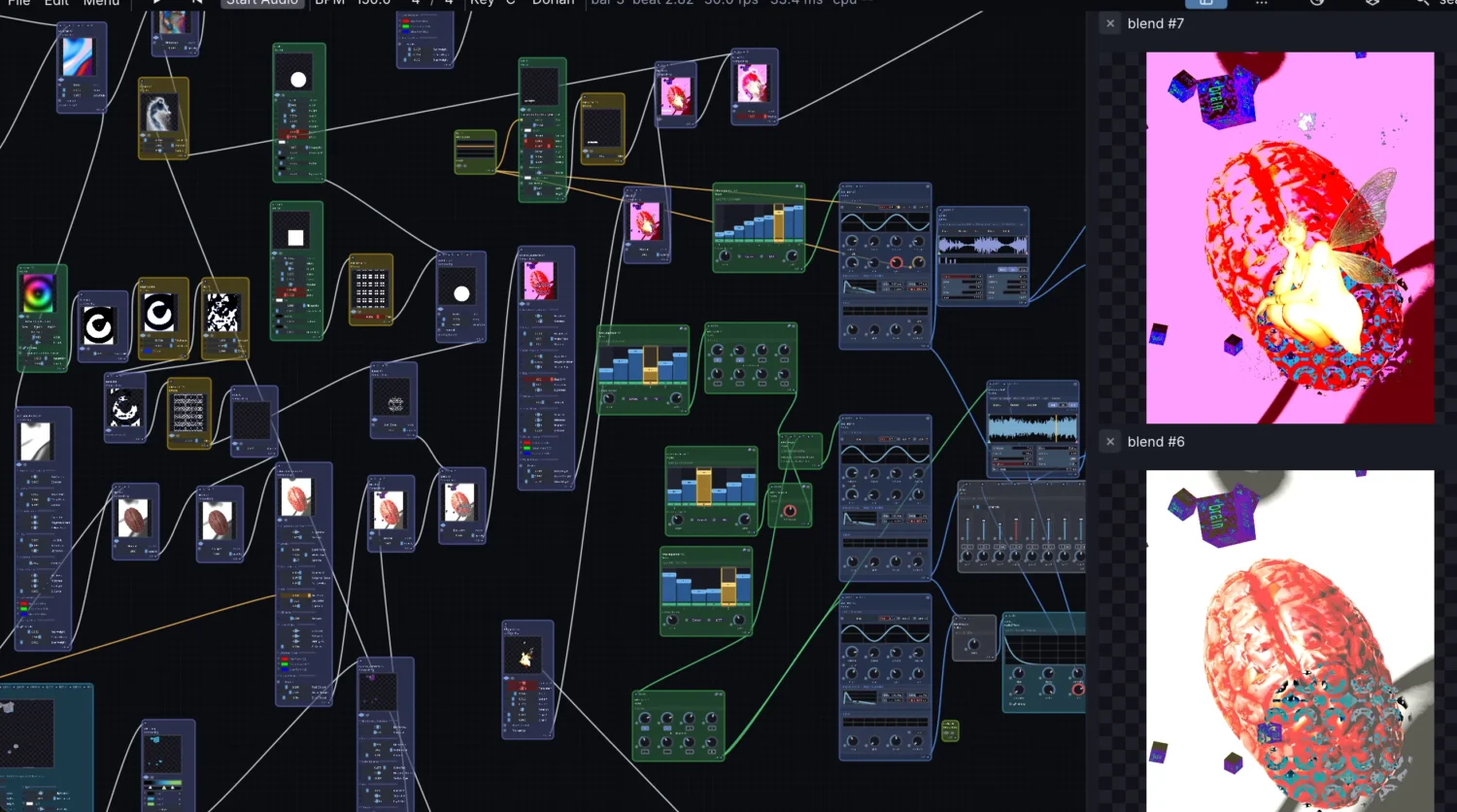
Rather than organizing every process around conventional tracks and separate plugin windows, Infinite uses a node-based canvas in which users connect synthesizers, effects, modulators, visual processors, and other components.
The software includes a range of synthesis and sequencing tools, audio effects, third-party plugin hosting, and facilities for creating real-time graphics and procedural 3D scenes. Its approach allows musical signals and control data to interact with visual elements, making it relevant to electronic musicians, sound designers, audiovisual performers, and VJs working with interconnected audio and image systems.
Features:
- Infinite organizes projects around a node-based canvas. Users can add individual components and connect them with virtual cables, creating custom signal paths and modular instruments without being restricted to a fixed arrangement of tracks or devices.
- The synthesis library includes wavetable, FM, analog-style, granular, string-modeling, and other sound-generation tools. Additional options include a metallic resonator, partial-based resynthesis, and spectral processing, giving users several approaches to sound design within the same environment.
- MIDI and note-processing nodes provide tools for generating, routing, and transforming musical information. Available functions include MIDI input, arpeggiation, note sequencing, chord generation, quantization, humanization, and note routing, allowing users to construct generative patterns or build customized sequencing workflows.
- The software includes drum sequencing, sampling, and looping tools alongside its synthesizers. Users can combine these components with effects and modulation sources to build custom instruments, performance setups, and processing chains.
- Audio processing nodes include filters, equalization, dynamics, delay, reverb, chorus, phaser, saturation, bitcrushing, granular processing, and spectral stretching. These effects can be connected and controlled within the node graph rather than being confined to a conventional mixer-and-insert workflow.
- Modulation is a central part of Infinite’s design. LFOs, envelopes, random generators, MIDI control, and audio-analysis tools can influence parameters across the project. This makes it possible to connect musical activity to sound processing and visual behavior, including using audio levels or spectral information to control graphics.
- Infinite supports third-party plugin hosting, including VST3 and Audio Unit plugins on supported platforms. This allows users to incorporate external synthesizers and effects into projects alongside Infinite’s own nodes. Plugin format and operating-system compatibility depend on the host platform and build.
- Beyond audio, Infinite provides tools for image and video processing, compositing, generative effects, and procedural 3D geometry. Users can combine video sources, visual effects, shapes, particles, and 3D objects, with audio and modulation data available to influence visual parameters. These capabilities make the software suitable for developing music-responsive graphics, live visuals, and audiovisual performance systems.
- The embedded Field programming language provides a way to create custom behavior within the node environment. Instead of being limited to the built-in functions, users can write code for specialized processing and modulation tasks, extending the system for experimental synthesis, generative graphics, and other creative applications.
- Infinite also provides a library of nodes, patches, and examples, along with documentation and community development resources. Projects can be saved as portable files, making it possible to share node arrangements and creative setups with other users. The open-source codebase gives developers an additional route for studying the software and contributing to its development.
Infinite Overview:
Pricing & Availability:
Infinite is available free of charge for macOS 11 or later, Windows 10 or later, and Linux. The source code is available under the MIT license, while the default binary distribution includes bundled VST3 hosting components and is licensed under GPLv3; builds without VST3 hosting can be produced under the project’s MIT licensing terms. Downloads, release notes, documentation, and the source repository are available through the official Infinite website.

its a cool concept but it looks like a vibe-coded mess. A DAW should feel like an instrument, not a Unreal Engine blueprint diagram.
It’s a cool concept, but it looks like a vibe-coded mess. A DAW should feel like an instrument, not a Comfy UI node graph spaghetti explosion .