WMD shared this intro to the Modbox MKII, a multifunction modulation module designed to generate related control-voltage signals, synchronized rhythmic movement, and evolving random patterns.
Building on the original WMD/SSF Modbox concept, the MKII combines a Three Phase LFO, a variable-shape Skew LFO, a digital sample-and-hold circuit, and an analog noise generator.
Both oscillators support clock synchronization and 1V/octave tracking, and can operate at audio rates. The module’s additional sample-and-hold modes and probabilistic looping function provide further options for generating changing modulation without requiring a separate sequencer.
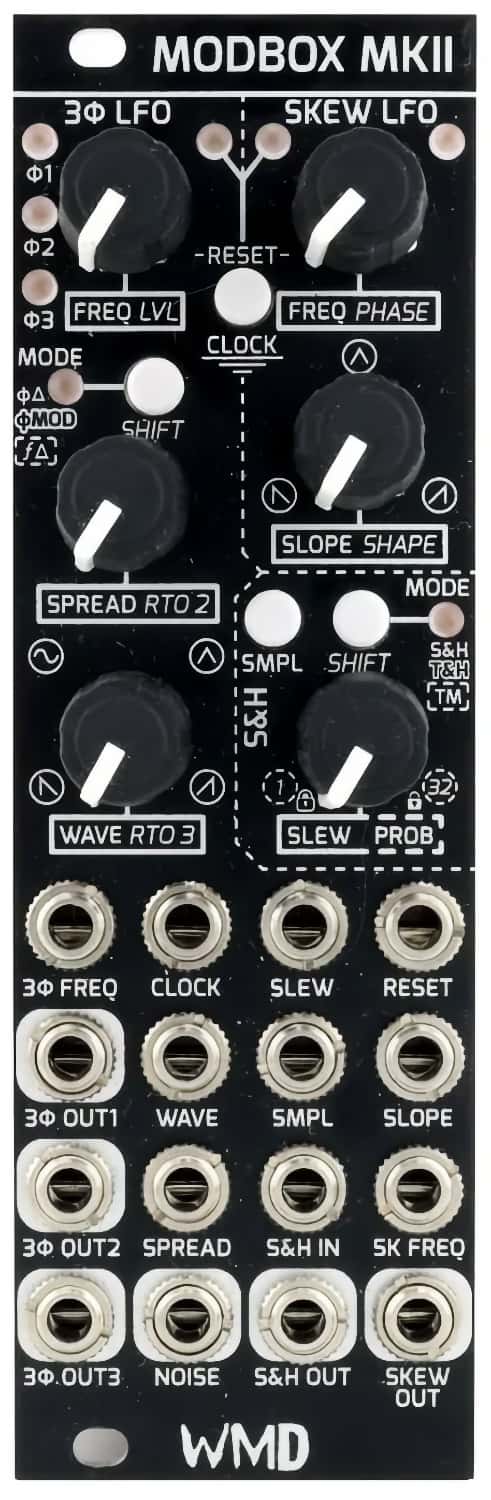 Features:
- The Three Phase LFO generates three related outputs and offers three operating modes. Phase Offset shifts the phase relationships between outputs, Phase Modulation introduces cascading phase distortion, and Frequency Spread changes the relative frequencies of the second and third outputs. The spread control can raise the second output to eight times the base frequency while lowering the third to one-eighth of that frequency.
- A waveform control continuously morphs the Three Phase LFO’s outputs through sawtooth, sine, triangle, and ramp shapes. Independent frequency ratios are available for the second and third outputs, and the oscillator supports 1V/octave tracking and audio-rate operation.
- The Skew LFO morphs between sawtooth, triangle, and ramp waveforms. Its slope control adjusts the waveform transition, while a separate shape function changes the curve from exponential through linear to logarithmic. Clock synchronization and adjustable phase behavior provide control over how the modulation aligns with incoming clock and reset signals.
- The Skew LFO also tracks 1V/octave and can operate at audio rates, allowing it to serve as either a modulation source or a source of oscillator-rate signals. When synchronized to an external clock, its rate control adjusts the relationship between the LFO and the incoming timing signal.
- The digital sample-and-hold section offers Sample & Hold, Track & Hold, and Turing Machine modes. Sample & Hold captures an input voltage at a trigger event, while Track & Hold follows the input while its gate is active and holds the voltage when the gate closes.
- In Turing Machine mode, the module stores a loop of sampled voltages and uses a probability control to determine whether new values enter the sequence or existing values repeat. The loop can be adjusted from one to 32 samples, producing patterns that range from changing random values to repeating or reversing sequences.
- An analog white-noise generator provides a noise source for the sample-and-hold circuit or other destinations in a patch. The noise output is also internally connected to the sample-and-hold input, allowing the module to generate random voltage patterns without an external noise source or additional patch cable.
- The Skew LFO’s pulse output is internally connected to the sample-and-hold trigger input. This normalled connection lets the oscillator clock the sampling process, creating synchronized random or looping patterns without requiring a separate trigger source.
- Clock and reset inputs support synchronized operation of the LFOs. The available clock ratios range from divisions as slow as 1:512 to multiplications up to 4:1, allowing modulation rates to follow a broader rhythmic structure. The clock and reset controls also provide selectable synchronization and reset behaviors.
- The Modbox MKII occupies 8HP of Eurorack space and has a listed depth of 38mm, including cables. Settings are saved after one minute of inactivity involving the Shift and Mode controls, and the module’s firmware can be updated in the field.
Pricing & Availability:
The WMD Modbox MKII is available now for $279 USD.
