Yamaha synthesizer
Articles about Yamaha synthesizer:
Yamaha S70XS
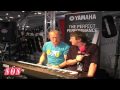
SOS’s Paul White got this demo of the new Yamaha S70 XS synthesizer at LIMS 2009:
Just in from Yamaha are the S70XS and S90XS performance keyboards. They both run on the same operating system, the only difference being the size of the key beds: the S70XS has 76 keys, while the S90XS has 88.
Both models have weighted, hammer-action keys so, even on the smaller model, users get the feel of a real piano.
On-board controls have been simplified by Yamaha so that only the most commonly used features are available to the user from the button-driven interface. This, the manufacturers say, provdies a less cluttered menu system that lets users access the most important parameters quickly and easily while on stage.
See this previous post for details on the Yamaha S70 XS and S90XS keyboard synthesizers.
LIMS 2009: Yamaha introduced two new synthesizers, the Yamaha S70XS and S90XS keyboards, with 76 & 88 keys.
Features:
- The sounds of the Motif XS plus a huge new S6 handcrafted grand piano sample
- 76/88 note Yamaha Balanced Hammer weighted action
- Performance Creator for instant splits, layers and drum performances
- 4 knobs, 16 backlit LEDs and tons of buttons for direct hands on control
- 1/4”/XLR Combo jack A/D input (with front panel controls) for adding vocals and guitars
- Direct to USB Stereo Audio record/ playback (plus 18 minutes of internal flash memory)
The Yamaha S series is scheduled to ship in August 2009, with MSRP list prices of $3,699 for the S70XS and $3,799 for the S90XS.
Check out the MusicRadar video overview from LIMS, above. Details below.
If you’ve had a chance to try out the new Yamaha S70XS and S90XS keyboard synthesizers, leave a comment! Read more…
Playing The Doctor Who Theme
Playing The Doctor Who theme
This is pretty geeky – but who doesn’t like the classic Dr Who theme?
via marinedalek:
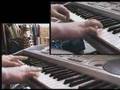
A quick video of me playing the Doctor Who theme. Bottom left is the bassline, and top right is the melody.
I used the keyboard (Yamaha PSR-275) as a MIDI controller to play two VST soft-synths loaded into ACID; Pro-53 for the bass and CS-80v for the sine melody.
I’ve now made a full-length remix of the seperate tracks from this video with extra instruments, which can be heard here: http://files.marinedalek.co.uk/music/playingremix.mp3
Send to a Friend
|
Feed for this Entry |
Filed under: Keyboard Synthesizers, Music Videos, Strange, Synthesizers
Bach Little Fugue: Tesla Coil vs Yamaha Synth
Description:
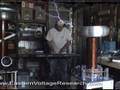
This video captures a quick and dirty demonstration of the XenoSonic Audio Interface, plus – to make it interesting – a Tesla Coil shooting a 4 foot arc of electricity.
Is this the ultimate Switched-On Bach?
A Yamaha S03 Synthesizer is hooked up directly to the miniBrute DRSSTC, via the XenoSonic Audio Interface.
Since the XenoSonic only produces monophonic output, the Bach Fugue in Gminor was pre-recorded on an Allen C-6 Classical organ and then various voices were added using the Yamaha S03 in real time to the Tesla coil.
Says eastvoltresearch: “Its quite a bit sloppy, but that’s mostly because i didn’t really practice how i was going to play individual voices from the piece and I had a hard time hearing the actual prerecorded music, so its a bit out of sync. Anyways, enjoy.”
More information and details can be found at Eastern Voltage Research.
via eastvoltresearch
Send to a Friend
|
Feed for this Entry |
Filed under: Keyboard Synthesizers, Music Videos, Strange, Synthesizers
Yamaha Synth Cross Bent With a 486 computer motherboard
Description:
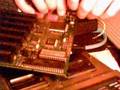
What do you get when you mate a Yamaha synthesizer with a 486 motherboard?
It’s not pretty!
Says circuit bender creepingnet:
(WARNING): This video too is not for mainstream consumption, actually, this video has lots of..ummm…interesting sounds, a few volume tweaks, and general mayhem. So if you are looking for a good song to dance to, this ain’t it.
Now, I circuit bent my Yamaha PSS-80 with 3 wires attached to some blue thing on the circut board, and to the ground. In this one, I’m shorting the wires out against parts of an IBM 486 SLC motherboard that’s pretty much long gone as working goes. It’s kind of odd that it makes THAT much of a difference between just doing the usual bends, and shorting out through a motherboard chipset, and even the 486 SLC Processor itself.
Somebody should have used protection!
Let me know what you think of this Yamaha synth/486 cross-bending in the comments!
via creepingnet