Nagi is a new desktop application for designing and building native audio plugins, with no manual coding required.
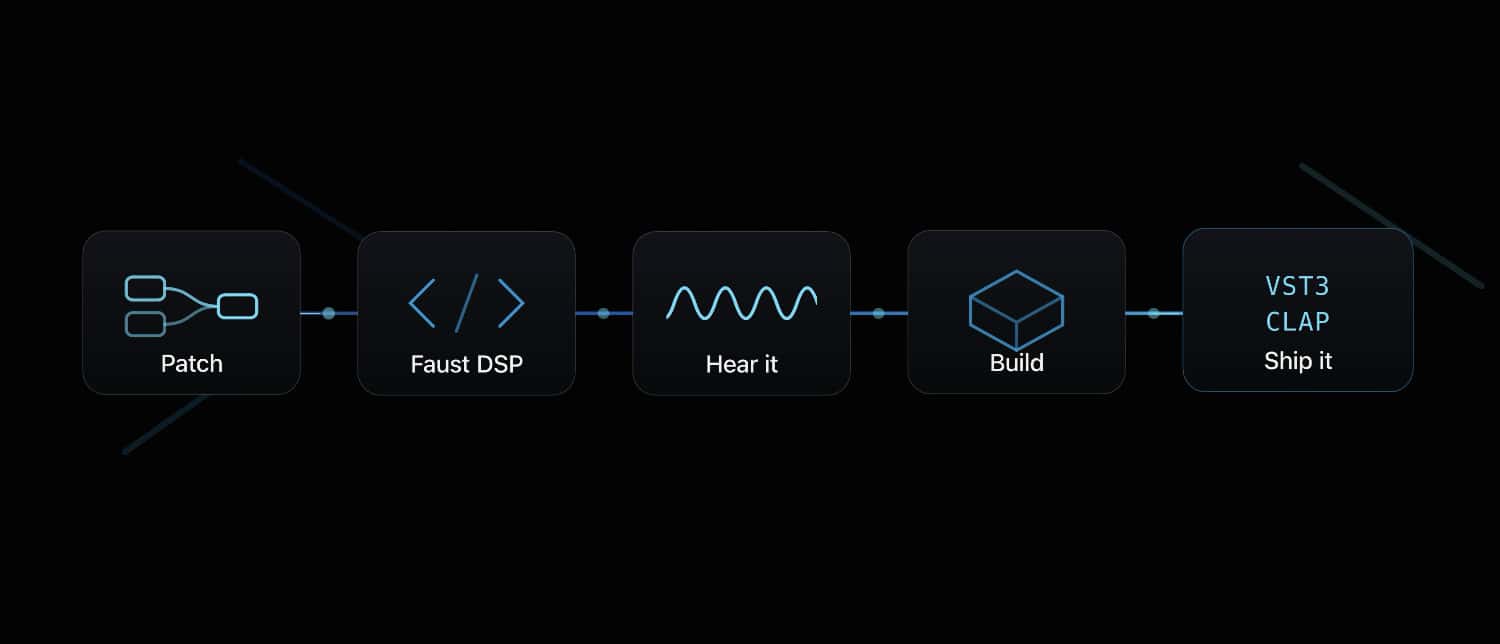
Nagi’s workflow combines a visual node editor, Faust DSP code and an interface designer in a single application, with an integrated audio preview that lets users hear a patch before compiling it.
The node editor provides audio, MIDI and parameter ports and includes ready-made nodes for functions including oscillators, filters, dynamics, reverb, chorus, flanger, de-essing, formant filtering and stereo imaging. Users can switch from the visual graph to Faust code when more detailed DSP control is required.
Nagi also includes an AI assistant that can generate Faust DSP or GUI layouts from natural-language requests.
Features:
- Visual node editor for building DSP signal chains
- Audio, MIDI and parameter ports on a single canvas
- Ready-made nodes for oscillators, filters, dynamics and effects
- Reverb, compressor, chorus, flanger, de-esser, formant filter and stereo imager nodes
- Knob, slider and button nodes that bind directly to parameters
- Integrated Faust DSP editor
- Full Faust standard library support
- Syntax highlighting and inline diagnostics
- Built-in GUI/interface designer
- Knobs, sliders, buttons, meters and spectrum displays
- Envelope displays, filmstrip animations, keyboards and preset browsers
- Per-widget range, skew and response-curve controls
- Local AI assistant for generating Faust DSP or GUI layouts
- AI-generated material can be replaced or added to an existing project
- In-app audio preview before compiling
- Native VST3 and CLAP plugin output
- Windows, macOS and Linux support
- Universal macOS binaries for Intel and Apple Silicon
- MIDI instrument plugin support
- Project files stored locally without requiring an account to build
Pricing & Availability:
Nagi is currently available as a public beta. The core application is free to download, patch and build plugins, with no account required for those functions. During the beta phase, the Nagi Pro evaluation license is listed at $0 and supports three machines. Final pricing is to be announced.
