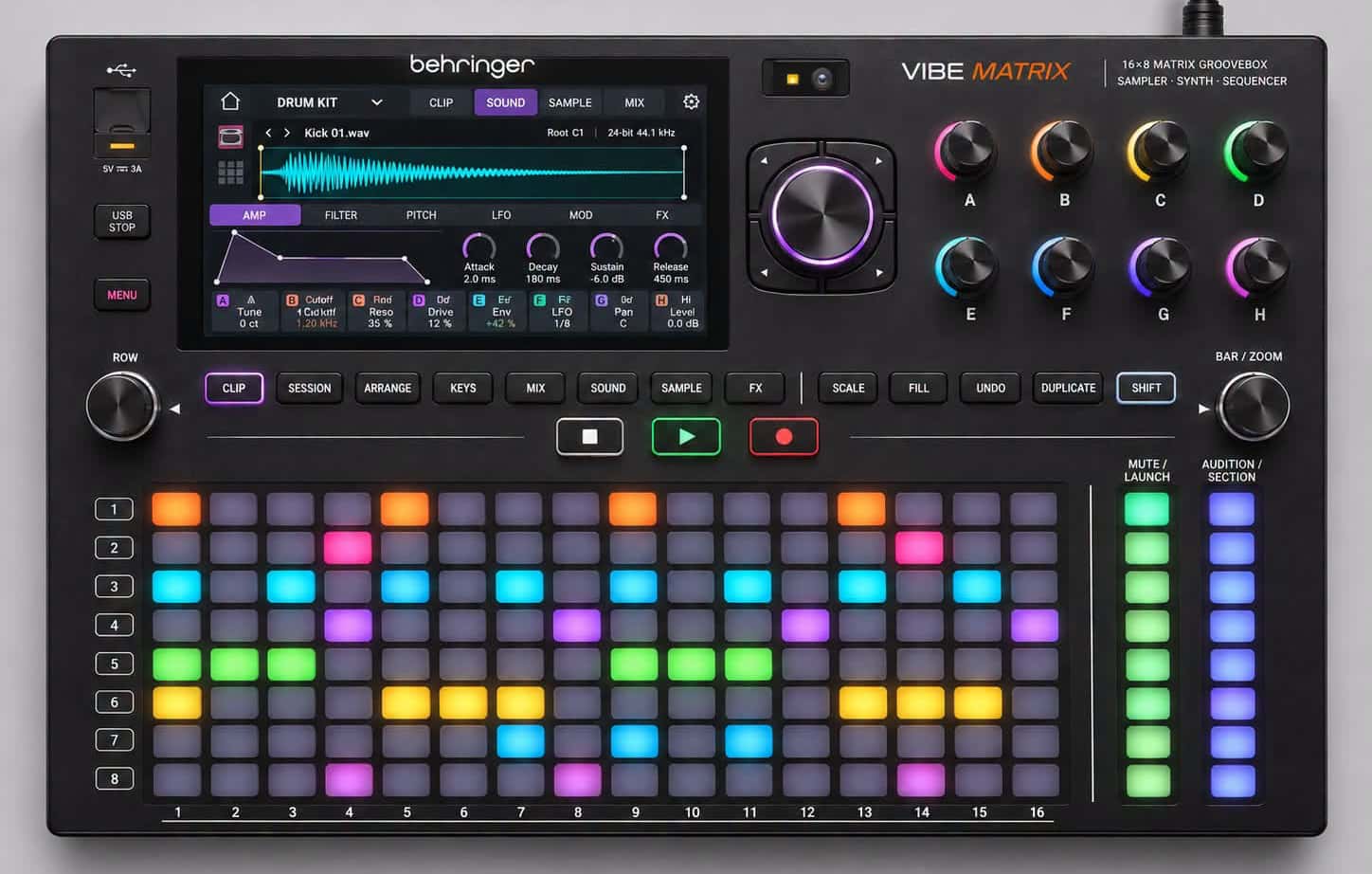
Behringer shared this teaser image for the Vibe Matrix groovebox, a design concept that embraces the vibe coding trend, and promises to be anything that you want it to be.
The say that they’re hoping to bring prototypes to the 2027 NAMM Show for a ‘hackathon’.
The company is looking for feedback on the concept on their Facebook page:
“What do you think of this design for a powerful groovebox featuring polyphonic sequencing, sampling, synthesis, live looping, clip launching and a customizable control interface? Our vision is an affordable, open hardware platform that anyone can customize, vibe-code and turn into whatever they imagine.
This is just a concept, not a product announcement. If there’s enough community interest, we’ll build it! We’ll also try to bring a few prototypes to NAMM in Anaheim for our hackathon.
Would you want one? What features would you add, what would you improve, and what price would make it irresistible? Your feedback will help us decide whether to make it happen!”
Interested in the Behringer Vibe Matrix? Let us know what you think in the comments!

I like this and I hope they make it. This is basically a perkons/oxi one/hapax layout fused with elektron. It will make a killer interface for a groovebox or drum machine.
Been waitin’ forever for a Synthstrom Deluge mk2. This might be a purchase to fill that spot in my setup…
Copy of deluge
1:1 copy starting with the screen.
Akai released the MPC Live III with the most complex, convoluted, confusing user interface ever made. Suddenly, from out of nowhere comes Uli saying, “Here, hold my beer.”
Performance and recording functions mashed side by side in the least expected locations? That Play button right beside the Sample button? Oh, noooo! Fill beside Undo? $%^&!
Vibe coding won’t fix that. Button names that no longer mean anything related to vibe coded functions won’t be better…
But it would be fun to have the camera capture the player’s facial expressions when, right in the middle of a live set, the player hits the wrong little chicklet button and mutters a dirty word. Imagine that on a big screen above the stage. Or endless viral videos under the heading GrooveFlocks. DJ Dohs? JamCam Fails 2027?
Great job, team. NAMM 2027 Slopbox of the Year!
UI is absolutely fine as it is.
If you have no muscle memory and hit the wrong buttons that’s on you.
Maybe. Could be my own lack of finese and skill.
But I cannot think of a single successful sequencer or performance-oriented groovebox that has the transport controls in the middle. Akai MPC, Roland 404s and MCs, Polyend’s Tracker, the early Buchla and Moog CV sequencers, Oxi, Deluge, Maschine, Arturia’s Beatsteps, Novation Launchpad, Korg SQ10, Donner D1. Maybe Digitakt does, kind of middle left?
Transport controls are flush left or flush right, top or sometimes bottom, but not the middle. True from the days of reel-to-reel tape decks to DAWs. Edges always, not the middle. There is a reason for that.
If there is not already a stack of these in a warehouse in China, I would fix it now. This mistake cannot be cured with vibe coding.
I’m with @Concerned Synthesist on this one. The entire layout looks like chatGPT from 5 years ago; no human perspective. It imposes its idea of what a groovebox is onto you. In order to differentiate itself from a tablet or laptop, buttons and knobs below and beside the screen are key. There needn’t be a touch screen, but that does add some possibilities, especially if the user can opt-out.
1. All button labels should be scribble strips or overlays, nothing permanently inked.
2. Much larger hi-res display.
3. Cursor diamond and center push-encoder. What’s up with that 2 left & 2 right cluster-F?!
4. I personally don’t want a big 8 x 16 grid on the device. Either have a touch screen do that, or an attachable button box, or just a mode for the assignable buttons. I get that for many, that’s what a groove box is, but it’s a concrete, windowless room.
5. Always put all the hands-on controls on the lower part or side so you never block the visual parts of the UI with your hands.
6. 5-pin MIDI DIN IN/OUT/THRU. I know this dates me, but it is a robust time-tested, and flexible spec. Not everything in this world needs to be razor thin. Use the added chassis size for heat sinks.
7. Make the hardware/processor/CPU as over-powered as possible. Choose components and architecture that provide ultra-tight timing with plenty of overhead.
8. No internal battery. Let users choose their power bank.
9. Built it to last– as future-proof as possible, keep it out of landfill for decades.
I agree with points 6 and 7 only.
it’s spelled Behringer. not Berhringer.
Is that a camera at the top? Hope they don’t use that to steal our identities. Not that they’d ever steal… They’ll just offer a more affordable version of our identity to people interests in that option.
The concept of an instrument combining the best features – naturally enhanced in line with current capabilities – of Yamaha’s RM1x, Pioneer’s SP-16, the Access Virus TI2 and a few other high-quality gems, all featuring ergonomic controls, a decent-sized screen and ample memory – that would be the ideal instrument, and I wouldn’t hesitate for a moment to buy two or three of them, simply so I could have one handy wherever I am when inspiration strikes and I need to get on with my music. In short, a truly wonderful machine for creating sonic dreams, promising years of enjoyment.