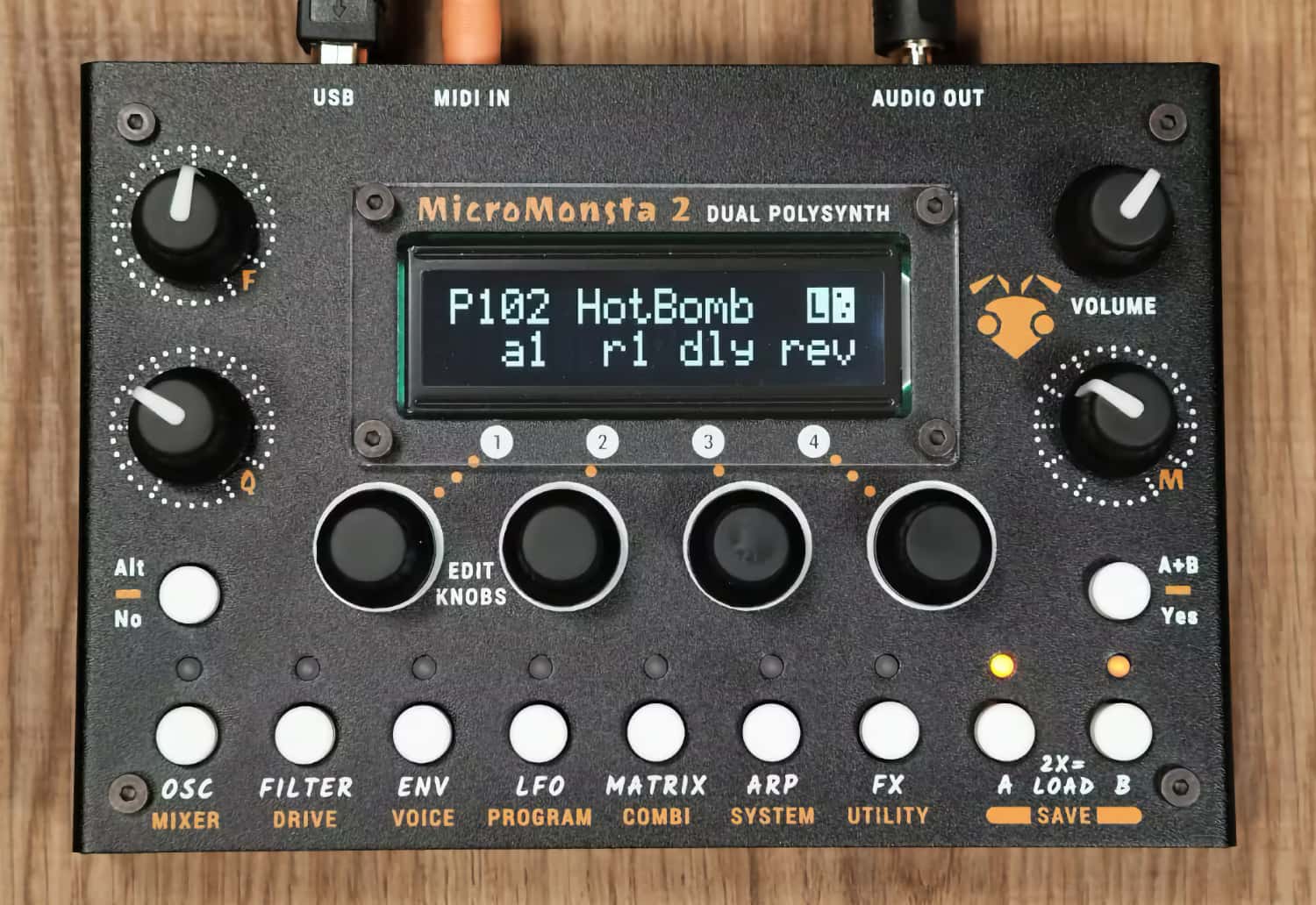
AudioThingies has released firmware 3.0 for the MicroMonsta 2, a bi-timbral digital synthesizer, introducing a substantial collection of performance, sequencing and sound-design improvements.
The update adds polyphonic aftertouch support, allowing individual notes to respond independently to pressure when used with a compatible controller. Presets configured for aftertouch will respond to either channel or polyphonic aftertouch without requiring additional configuration.
The synthesizer’s internal keyboard, scaler and chorder have also been redesigned. The updated system offers 21 scales and 63 chord types, including different three- and four-note voicings. Users can assign different chord types to individual notes within a scale, with keyboard, scaler and chorder settings now saved independently with each preset.
Firmware 3.0 also expands the MicroMonsta 2’s modulation capabilities. A second 16-step modulation sequence synchronized to the arpeggiator has been added, along with two additional modulation matrix slots and new destinations for effects, envelopes, oscillators and arpeggiator parameters.
Other changes include revised filter resonance behavior, an updated soft-clipping algorithm, expanded oscillator tuning and a new Scale mode designed to prevent parameter values from jumping when turning the synthesizer’s encoders.
Features:
- Polyphonic aftertouch support allows individual notes to respond independently to pressure from compatible MIDI controllers.
- Presets configured for aftertouch respond to either channel or polyphonic aftertouch without requiring additional configuration.
- Redesigned internal keyboard, scaler and chorder are now available in all operating modes, including MPE mode.
- The updated scaler offers 21 musical scales and 63 chord types, including 27 three-note and 36 four-note voicings.
- Chord selections include open triads, suspended chords, sixth-ninths, extended shells, rootless ninths, thirteenths, fourth and fifth stacks, and clusters.
- Different chord types can be assigned to individual notes within a selected scale, allowing each note to trigger a different voicing.
- The internal scaler and chorder can also be played using incoming MIDI notes.
- Keyboard, scaler and chorder configurations can now be saved individually with each preset rather than being shared globally.
- A second 16-step modulation sequence has been added, synchronized to the synthesizer’s arpeggiator.
- Each modulation sequence step can generate low, mid, high or random values, with unipolar or bipolar output available.
- The new modulation sequence can affect an entire program or individual generated notes.
- The modulation matrix has been expanded from 10 to 12 slots.
- New modulation destinations include delay time, feedback and level, reverb level, envelope sustain, oscillator shape and arpeggiator gate time.
- Arpeggiator gate-time modulation can create overlapping notes for legato slides.
- A new Scale mode for the synthesizer’s encoders prevents parameter values from jumping when a control is turned. Jump mode remains available as an alternative.
- Filter resonance behavior has been revised, with consistent self-oscillation levels across the frequency range and additional low-pass filter self-oscillation behavior.
- Two filter response modes, MM2 and VNT, replace the previous Soft, Mild, Hard and Mean resonance modes.
- The soft-clipping algorithm has been updated to provide a more analog-style response.
- Coarse tuning ranges for all three oscillators have been expanded from -24 to +12 semitones to -24 to +24 semitones.
Pricing & Availability:
MicroMonsta 2 firmware 3.0 is available as a free update for existing owners.
