Guitarists may get more chicks – but keyboardists have always had them beat in the technology department. That distinction may not last, though, based on some of the releases at this year’s NAMM show.
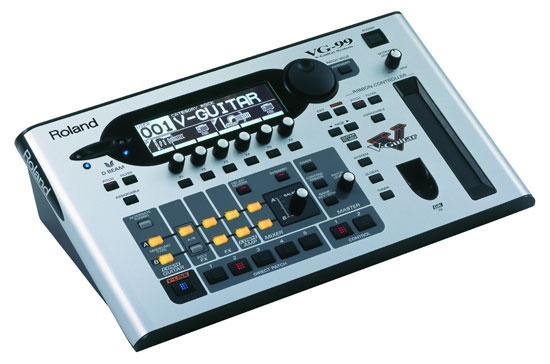
Roland introduced an advanced guitar processor – the VG-99. With three processors at its core, plus expressive performance controls such as a ribbon controller and dual D BEAMs, and a versatile housing that allows for on-stage, tabletop, or rack mounting, the device raises the bar in guitar-modeling and performance technology.
The VG-99 contains a wide range of guitars and amplifier models, and it even models two signal paths at once. For example, one virtual guitar could be a Les Paul and the other a nylon-string guitar. Add to this the sound of the actual guitar being played, and it’s possible to simultaneously have the sound of three different guitars playing simultaneously.
But that’s not all the system does. It also sports a guitar-to-MIDI converter, letting you use your guitar to control your synth gear.
Modeled guitar, amp and effects paths can be active at the same time, or they can be dynamically switched or blended. Players can control the switching behavior between virtual guitars and/or amps by foot controllers, buttons on the unit, or according to picking dynamics.
The device also includes an onboard guitar-to-MIDI converter for direct connection to keyboards, sound modules and soft synths, a digital out and a USB port for direct audio and MIDI connection to computers. The VG-99 also boasts an intuitive and state-of-the-art on-screen patch editor.
A new Freeze feature onboard the VG-99 makes it possible to play a chord or a single note and have Freeze sustain it until you decide to let it end, giving guitarists that controlled and unlimited sustain that they’ve been seeking.
Each modeled guitar in the VG-99 can have its own tuning: the virtual Les Paul could be tuned down four or five steps for a heavy sound, for example, while the nylon string could be tuned as a 12-string, and also tuned down four or five steps at the same time. Any user-defined tunings are also supported so the player can switch instantly between tuning setups without physically switching guitars or having to manually retune.
