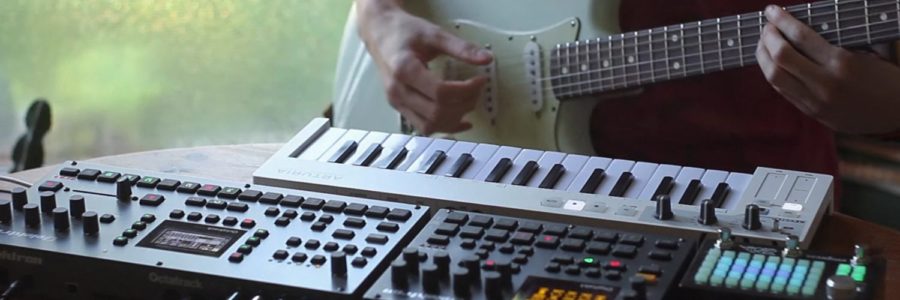
Sunday Synth Jam: This video, via RanKirlian, captures several soundscapes for guitar and iPad with csGrain.

Sunday Synth Jam: This video, via RanKirlian, captures several soundscapes for guitar and iPad with csGrain.

‘Effectology’ expert Bill Ruppert is back, with the latest in his series of videos that look at using effects pedals as a sort of modular synthesizer.
In his latest video, Ruppert explores the possibilities of granular synthesis, with Electro-Harmonix’s Superego Synth Engine. No keyboards, samplers or midi pickups were used.
For more info and pedal settings, see the EXH forum.

Developer Amedeo Farello sent word about his Mac software editor for the Roland GI-20 GK-MIDI guitar interface:
I have just completed version 2.0 of GI20Editor.
Besides being the only alternative to programming the device through a knob, a two digit display and a few buttons, GI20Editor can greatly simplify the guitar/synthesizer connection experienced through the GI-20.

Chris Stack of ExperimentalSynthesis demonstrates some of the possibilities of processing the Moog Guitar with the granular synthesis app, csGrain.

FabFilter has introduced a new distortion/saturation plugin for Mac & Windows, Saturn.
To be released on March 8, 2012, FabFilter Saturn is a multi-band distortion and saturation plug-in. According to FabFilter, it delivers ‘subtle, clean and warm tube or tape saturation to the wildest multi-band guitar amp effects’.
In this tutorial, Dan Worrall explains the basics of FabFilter Saturn. He starts with a simple single-band saturation example explaining the available algorithms and most important controls of the plug-in. Finally, he explains some more complex setups, using multiple bands and making use of the extensive modulation section.
Pricing is TBA.

Sunday Synth Jam: Josie Charlwood performs her live looping arrangement of Gorillaz‘ Feel Good Inc.
Technical details below.

At the 2012 NAMM Show, Roland and Fender announced the GC-1 GK-Ready Stratocaster guitar as one of the V-Guitar series, am electric guitar that can be directly connected to the GR-55 Guitar Synthesizer and VG-99 V-Guitar System.
Combining an authentic Stratocaster guitar and a special Roland divided pickup with a 13-pin output; the GK-Ready Stratocaster GC-1 can be used with both standard guitar equipment and Roland V-Guitar category products like the GR-55 and VG-99.
To harness this power, Roland developed the GK Divided Pickup, a special pickup that allows each of a guitar’s strings to be processed independently. Connecting a GK-Ready guitar to the GR Guitar Synthesizer or V-Guitar System opens up a world of options, including instant alternate tunings, transforming the guitar sound into another instrument entirely, and more.

At the 2012 NAMM Show, Roland and Fender announced the VG Stratocaster G-5, an electronic guitar that fuses traditional design with digital music technology.
Combining Roland’s COSM modelling with Fender’s classic Stratocaster guitar design, the VG Stratocaster G-5 gives players instant alternate tunings, a wide selection of electric, acoustic and 12-string guitar models and more.
The 20 sounds onboard the VG Stratocaster G-5 include Fender Stratocaster, Telecaster, humbucking, 12-string, acoustic models, and ‘cutting-edge’ sounds plus five alternate tunings.
At the 2012 NAMM Show, Alesis introduced the AmpDock a guitar effect adapter case for the iPad.
The AmpDock houses an iPad or iPad 2 in a durable enclosure that features a locking door, to protect the iPad on all sides.
The AmpDock’s inputs and outputs include a 1/4″ high-impedance guitar input and an XLR-1/4″ combo input for connecting a microphone, a second guitar or another instrument. The AmpDock also includes 1/4″ outputs with Guitar/Mic and Ground Lift switches, so you can connect to your guitar amp or go straight into a PA.
For use with software MIDI applications on your Mac or PC, the AmpDock also includes a USB MIDI port. A headphone output with volume control is also onboard, so you can practice and experiment with your apps at any time, day or night.
The AmpDock also comes with a pedalboard controller, which lets you control volume and other continuous controls, bypass, program changes, and other parameters. You can use the AmpDock with or without its pedalboard controller, and MIDI connections enable you to use the AmpDock with other pedal controllers and MIDI hardware.

Reader Julian Pröll, senior designer for the industrial design company formquadrat gmbh, sent us word about a new design concept for a touch-sensitive guitar, right.
The design, which explores the use of touch-sensitive plastics, combines multi-touch sensors with social media integration.
The guitar offers three primary touch fields (neck, drum area and touch wheel). It can connect wirelessly to a variety of devices.
The guitar is based on the touchskin technology developed by plastic electronic. touchskin provides capacitive technology on freely formed plastic part surfaces.
There’s not a lot of information on the formquadrat site about this touch sensitive design guitar design concept & Pröll did not leave contact info. If you’ve got more information on this design, leave a comment!